
Ch. 11 - Cell Communication
Campbell - Campbell Biology 11th Edition
Urry11th EditionCampbell BiologyISBN: 9789357423311Non è quello che usi tu?Cambia libro di testo
Capitolo 11, Problema 4

Consider this pathway: epinephrine → G protein-coupled receptor → G protein → adenylyl cyclase → cAMP. Identify the second messenger.
a. cAMP
b. G protein
c. GTP
d. Adenylyl cyclase

Guida verificata passo dopo passo
1
Understand the concept of a second messenger: In cell signaling, a second messenger is a molecule that relays signals received at receptors on the cell surface to target molecules inside the cell, creating a cascade effect.
Identify the components of the signaling pathway: The pathway given is epinephrine → G protein-coupled receptor → G protein → adenylyl cyclase → cAMP.
Recognize the role of each component: Epinephrine is the first messenger that binds to the G protein-coupled receptor, activating the G protein. The G protein then activates adenylyl cyclase.
Determine the function of adenylyl cyclase: Adenylyl cyclase is an enzyme that converts ATP to cyclic AMP (cAMP), which acts as a second messenger.
Identify the second messenger: In this pathway, cAMP is the molecule that acts as the second messenger, relaying the signal inside the cell.

Risposta video verificata per un problema simile:

Questa soluzione video è stata consigliata dai nostri tutor come utile per risolvere questo problema.
Durata del video:
2m

Concetti chiave

Ecco i concetti essenziali che devi comprendere per rispondere correttamente alla domanda.

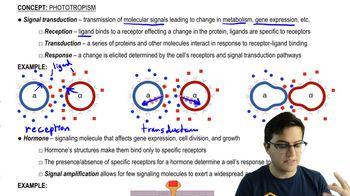
Signal Transduction Pathway

Signal transduction pathways are processes by which a cell converts an extracellular signal into a functional response. In this pathway, epinephrine binds to a G protein-coupled receptor, activating a cascade that leads to the production of cAMP, a second messenger that amplifies the signal within the cell.
Video consigliato:
06:56
Signal Transduction and Response

Second Messenger

Second messengers are molecules that relay signals received at receptors on the cell surface to target molecules inside the cell. In this pathway, cAMP acts as the second messenger, transmitting the signal from adenylyl cyclase to other cellular components, thereby facilitating the cellular response to epinephrine.
Video consigliato:
02:53
Second Law of Thermodynamics

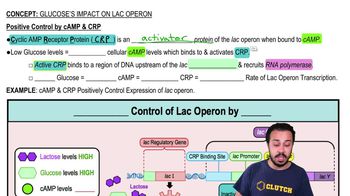
cAMP (Cyclic Adenosine Monophosphate)

cAMP is a crucial second messenger in many biological processes, including the epinephrine signaling pathway. It is synthesized from ATP by the enzyme adenylyl cyclase and plays a key role in regulating various cellular activities by activating protein kinase A, which phosphorylates target proteins to elicit specific cellular responses.
Video consigliato:
08:32
Positive Control by cAMP & CRP
Pratica correlata
Domanda del libro di testo

Lipid-soluble signaling molecules, such as aldosterone, cross the membranes of all cells but affect only target cells because

a. Only target cells retain the appropriate DNA segments.

b. Intracellular receptors are present only in target cells.

c. Only target cells have enzymes that break down aldosterone.

d. Only in target cells is aldosterone able to initiate the phosphorylation cascade that turns genes on.

1983
views
Domanda del libro di testo

The activation of receptor tyrosine kinases is characterized by

a. Dimerization and phosphorylation

b. Dimerization and IP3 binding.

c. A phosphorylation cascade

d. GTP hydrolysis

1781
views
Domanda del libro di testo

Which observation suggested to Sutherland the involvement of a second messenger in epinephrine's effect on liver cells?

a. Enzymatic activity was proportional to the amount of calcium added to a cell-free extract.

b. Receptor studies indicated that epinephrine was a ligand.

c. Glycogen breakdown was observed only when epinephrine was administered to intact cells.

d. Glycogen breakdown was observed only when epinephrine and glycogen phosphorylase were mixed.

1425
views
Domanda del libro di testo

Binding of a signaling molecule to which type of receptor leads directly to a change in the distribution of substances on opposite sides of the membrane?

a. Intracellular receptor

b. G protein-coupled receptor

c. Phosphorylated receptor tyrosine kinase dimer

d. Ligand-gated ion channel

1590
views
Domanda del libro di testo

Protein phosphorylation is commonly involved with all of the following except

a. Activation of receptor tyrosine kinases

b. Activation of protein kinase molecules

c. Activation of G protein-coupled receptors

d. Regulation of transcription by signaling molecules

2679
views
Domanda del libro di testo

Apoptosis involves all but which of the following?

a. Fragmentation of the DNA

b. Cell-signaling pathways

c. Lysis of the cell

d. Digestion of cellular contents by scavenger cells

2487
views