
Ch. 12 - The Cell Cycle
Campbell - Campbell Biology 11th Edition
Urry11th EditionCampbell BiologyISBN: 9789357423311Non è quello che usi tu?Cambia libro di testo
Capitolo 12, Problema 1

Through a microscope, you can see a cell plate beginning to develop across the middle of a cell, and nuclei forming on either side of the cell plate. This cell is most likely
a. An animal cell in the process of cytokinesis
b. A plant cell in the process of cytokinesis
c. A bacterial cell dividing
d. A plant cell in metaphase

Guida verificata passo dopo passo
1
Understand the process of cytokinesis: Cytokinesis is the division of the cytoplasm of a parent cell into two daughter cells. In plant cells, this involves the formation of a cell plate, while in animal cells, a cleavage furrow forms.
Identify the key observation: The problem states that a cell plate is beginning to develop across the middle of the cell, and nuclei are forming on either side of the cell plate.
Relate the observation to plant cells: In plant cells, cytokinesis occurs through the formation of a cell plate, which eventually develops into a new cell wall separating the two daughter cells. This is different from animal cells, which use a cleavage furrow.
Consider the options: The presence of a cell plate indicates that the cell is undergoing cytokinesis in a plant cell, as this is characteristic of plant cell division.
Eliminate incorrect options: Since a cell plate is not involved in animal cell cytokinesis or bacterial cell division, and metaphase is a stage of mitosis where chromosomes align in the center of the cell, the correct answer is that the cell is a plant cell in the process of cytokinesis.

Risposta video verificata per un problema simile:

Questa soluzione video è stata consigliata dai nostri tutor come utile per risolvere questo problema.
Durata del video:
1m

Concetti chiave

Ecco i concetti essenziali che devi comprendere per rispondere correttamente alla domanda.

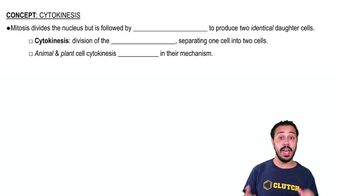
Cytokinesis

Cytokinesis is the process during cell division where the cytoplasm of a single eukaryotic cell is divided to form two daughter cells. In plant cells, cytokinesis involves the formation of a cell plate, which eventually develops into the cell wall separating the two new cells. This is distinct from animal cells, which form a cleavage furrow during cytokinesis.
Video consigliato:
01:25
Cytokinesis

Cell Plate Formation

Cell plate formation is a key feature of cytokinesis in plant cells. It begins with the assembly of vesicles derived from the Golgi apparatus at the center of the cell, which coalesce to form the cell plate. This structure grows outward until it fuses with the cell membrane, leading to the separation of the two daughter cells and the formation of a new cell wall.
Video consigliato:
04:33
Plate Tectonics and Continental Drift

Plant Cell Division

Plant cell division involves unique processes compared to animal cells, particularly during cytokinesis. The presence of a rigid cell wall necessitates the formation of a cell plate to divide the cell. Observing a cell plate and nuclei forming on either side indicates that the cell is undergoing cytokinesis, a stage following mitosis where the cell physically splits into two distinct cells.
Video consigliato:
03:19
Importance of Cell Division