Ch. 14 - Mendel and the Gene Idea
Campbell - Campbell Biology 11th Edition
Urry11th EditionCampbell BiologyISBN: 9789357423311Non è quello che usi tu?Cambia libro di testo
Capitolo 14, Problema 1

Two pea plants heterozygous for the characters of pod color and pod shape are crossed. Draw a Punnett square to determine the phenotypic ratios of the offspring.

Guida verificata passo dopo passo
1
Step 1: Identify the genotypes of the parent pea plants. Since both are heterozygous for pod color and pod shape, their genotypes are AaBb, where 'A' represents the dominant allele for pod color, 'a' represents the recessive allele for pod color, 'B' represents the dominant allele for pod shape, and 'b' represents the recessive allele for pod shape.
Step 2: Determine the possible gametes produced by each parent. Use the principle of independent assortment to find all combinations of alleles. Each parent can produce four types of gametes: AB, Ab, aB, and ab.
Step 3: Construct a Punnett square. Create a 4x4 grid where the rows represent the gametes from one parent and the columns represent the gametes from the other parent. Fill in each cell by combining the alleles from the corresponding row and column.
Step 4: Analyze the genotypes in the Punnett square. Count the number of occurrences of each genotype and group them based on their phenotypes. Remember that dominant alleles mask recessive alleles, so any genotype with at least one 'A' will have the dominant pod color, and any genotype with at least one 'B' will have the dominant pod shape.
Step 5: Determine the phenotypic ratios. Based on the combinations in the Punnett square, calculate the ratio of offspring with each phenotype (e.g., dominant pod color and dominant pod shape, dominant pod color and recessive pod shape, etc.).

Risposta video verificata per un problema simile:

Questa soluzione video è stata consigliata dai nostri tutor come utile per risolvere questo problema.
Durata del video:
9m

Concetti chiave

Ecco i concetti essenziali che devi comprendere per rispondere correttamente alla domanda.

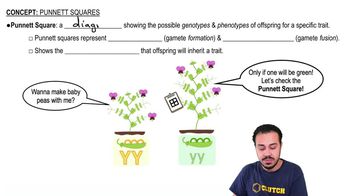
Punnett Square

A Punnett square is a diagram used to predict the genotypes and phenotypes of offspring from a genetic cross. It organizes the possible combinations of alleles from each parent, allowing for a visual representation of inheritance patterns. In this case, it will help determine the ratios of different phenotypes resulting from the cross of two heterozygous pea plants.
Video consigliato:
01:37
Punnett Squares

Heterozygous

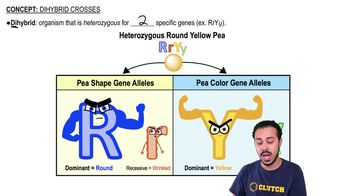
Heterozygous refers to an organism that has two different alleles for a particular gene, one inherited from each parent. In the context of the pea plants, being heterozygous for pod color and pod shape means that each plant carries one dominant and one recessive allele for these traits. This genetic variation is crucial for understanding the potential outcomes in the offspring.
Video consigliato:
02:37
Dihybrid Crosses

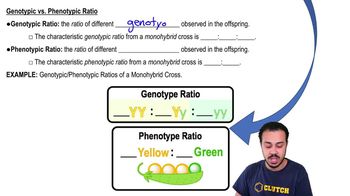
Phenotypic Ratio

The phenotypic ratio is the relative frequency of different phenotypes in the offspring resulting from a genetic cross. It is calculated by analyzing the outcomes from the Punnett square. For the pea plants, this ratio will indicate the proportion of offspring exhibiting specific traits, such as pod color and shape, based on the combinations of alleles inherited.
Video consigliato:
02:48
Genotypic vs. Phenotypic Ratio