Ch. 27 - Bacteria and Archaea
Campbell - Campbell Biology 11th Edition
Urry11th EditionCampbell BiologyISBN: 9789357423311Non è quello che usi tu?Cambia libro di testo
Capitolo 27, Problema 3

Which of the following statements is true?
a. Archaea and bacteria have identical membrane lipids.
b. The cell walls of archaea lack peptidoglycan.
c. Prokaryotes have low levels of genetic diversity.
d. No archaea are capable of using CO₂ to oxidize H₂, releasing methane.

Guida verificata passo dopo passo
1
Step 1: Begin by analyzing each statement individually to determine its accuracy based on biological principles and facts.
Step 2: Evaluate statement (A): 'Archaea and bacteria have identical membrane lipids.' Recall that archaea have unique membrane lipids composed of ether linkages, while bacteria have membrane lipids with ester linkages. This makes the statement false.
Step 3: Evaluate statement (B): 'The cell walls of archaea lack peptidoglycan.' Understand that archaea do not have peptidoglycan in their cell walls; instead, they have pseudopeptidoglycan or other unique polymers. This statement is true.
Step 4: Evaluate statement (C): 'Prokaryotes have low levels of genetic diversity.' Consider that prokaryotes exhibit high genetic diversity due to mechanisms like horizontal gene transfer, mutations, and rapid reproduction. This statement is false.
Step 5: Evaluate statement (D): 'No archaea are capable of using CO2 to oxidize H2, releasing methane.' Methanogenic archaea are well-known for their ability to use CO2 to oxidize H2, producing methane as a byproduct. This statement is false.

Risposta video verificata per un problema simile:

Questa soluzione video è stata consigliata dai nostri tutor come utile per risolvere questo problema.
Durata del video:
2m

Concetti chiave

Ecco i concetti essenziali che devi comprendere per rispondere correttamente alla domanda.

Differences between Archaea and Bacteria

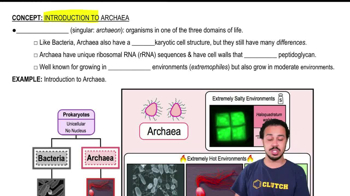
Archaea and bacteria are both prokaryotic organisms, but they differ significantly in their membrane lipids and cell wall composition. Archaea have unique ether-linked lipids, while bacteria typically have ester-linked lipids. This distinction is crucial for understanding their evolutionary relationships and environmental adaptations.
Video consigliato:
04:39
Introduction to Archaea

Cell wall composition in Archaea

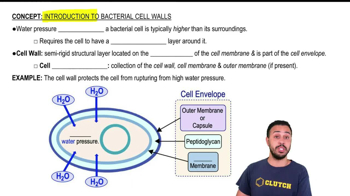
Unlike bacteria, which have cell walls composed of peptidoglycan, archaea possess cell walls made of various materials, such as pseudopeptidoglycan or proteins. This difference is significant in microbiology, as it affects the susceptibility of these organisms to antibiotics and their ecological roles.
Video consigliato:
03:44
Introduction to Bacterial Cell Walls

Genetic diversity in Prokaryotes

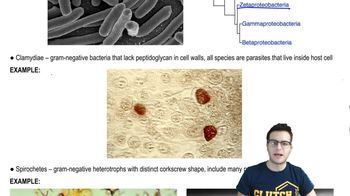
Prokaryotes, including both archaea and bacteria, exhibit high levels of genetic diversity due to mechanisms such as horizontal gene transfer, mutation, and rapid reproduction. This genetic variability allows them to adapt quickly to changing environments, contrary to the statement suggesting low diversity.
Video consigliato:
03:51
Prokaryote Lineages 1