Ch. 28 - Protists
Campbell - Campbell Biology 11th Edition
Urry11th EditionCampbell BiologyISBN: 9789357423311Non è quello che usi tu?Cambia libro di testo
Capitolo 28, Problema 3

Which group is incorrectly paired with its description?
a. Diatoms—important producers in aquatic communities
b. Red algae—eukaryotes that acquired plastids by secondary endosymbiosis
c. Apicomplexans—unicellular parasites with intricate life cycles
d. Diplomonads—unicellular eukaryotes with modified mitochondria

Guida verificata passo dopo passo
1
Step 1: Begin by understanding the characteristics of each group mentioned in the options. Diatoms are a type of algae known for their silica cell walls and are indeed important producers in aquatic ecosystems.
Step 2: Examine red algae. They are eukaryotic organisms that contain plastids, but these plastids were acquired through primary endosymbiosis, not secondary endosymbiosis. This is a key point to consider.
Step 3: Consider apicomplexans. These are unicellular parasites, such as Plasmodium, which have complex life cycles often involving multiple hosts. This description is accurate.
Step 4: Look at diplomonads. These are unicellular eukaryotes, such as Giardia, that have modified mitochondria known as mitosomes. This description is correct.
Step 5: Compare each description with the known characteristics of the groups. Identify the group whose description does not match its known biological features, focusing on the distinction between primary and secondary endosymbiosis in red algae.

Risposta video verificata per un problema simile:

Questa soluzione video è stata consigliata dai nostri tutor come utile per risolvere questo problema.
Durata del video:
2m

Concetti chiave

Ecco i concetti essenziali che devi comprendere per rispondere correttamente alla domanda.

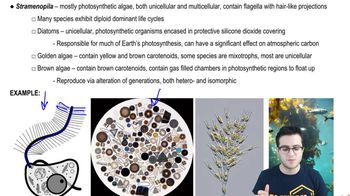
Diatoms

Diatoms are a major group of algae and are among the most common types of phytoplankton. They are important producers in aquatic communities, contributing significantly to the global carbon cycle through photosynthesis. Diatoms have silica cell walls, which give them a unique and intricate appearance under a microscope.
Video consigliato:
10:24
Stramenopila and Alveolata

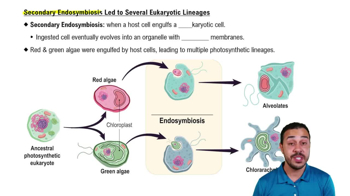
Secondary Endosymbiosis

Secondary endosymbiosis refers to the process by which a eukaryotic cell engulfs another eukaryotic cell that has already undergone primary endosymbiosis. This process is believed to have led to the acquisition of plastids in certain algae, such as red algae, allowing them to perform photosynthesis. It is a key concept in understanding the evolution of complex cells.
Video consigliato:
02:37
Secondary Endosymbiosis Led to Several Eukaryotic Lineages

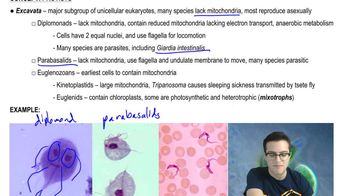
Diplomonads

Diplomonads are a group of unicellular eukaryotes characterized by having modified mitochondria known as mitosomes, which lack the ability to perform oxidative phosphorylation. They are often parasitic, with Giardia lamblia being a well-known example that causes gastrointestinal infections in humans. Understanding their unique cellular structure is crucial for studying their biology and pathogenicity.
Video consigliato:
05:57
Excavata and Archaeplastida (Plantae)
Pratica correlata
Domanda del libro di testo

Biologists think that endosymbiosis gave rise to mitochondria before plastids partly because

a. The products of photosynthesis could not be metabolized without mitochondrial enzymes.

b. All eukaryotes have mitochondria (or their remnants), whereas many eukaryotes do not have plastids.

c. Mitochondrial DNA is less similar to prokaryotic DNA than is plastid DNA.

d. Without mitochondrial CO2 production, photosynthesis could not occur.

2330
views
Domanda del libro di testo

Plastids that are surrounded by more than two membranes are evidence of

a. Evolution from mitochondria.

b. Fusion of plastids.

c. Origin of the plastids from archaea.

d. Secondary endosymbiosis.

2247
views
Domanda del libro di testo

According to the phylogeny, which protists are in the same eukaryotic supergroup as plants?

a. Green algae

b. Dinoflagellates

c. Red algae

d. Both A and C

824
views
Domanda del libro di testo

In a life cycle with alternation of generations, multicellular haploid forms alternate with

a. Unicellular haploid forms

b. Unicellular diploid forms

c. Multicellular haploid forms

d. Multicellular diploid forms

1174
views
Domanda del libro di testo

Based on the phylogenetic tree in Figure 28.2, which of the following statements is correct?

a. The most recent common ancestor of Excavata is older than that of SAR.

b. The most recent common ancestor of SAR is older than that of Unikonta.

c. The most basal (first to diverge) eukaryotic supergroup cannot be determined.

d. Excavata is the most basal eukaryotic supergroup.

894
views