Ch. 30 - Plant Diversity II: The Evolution of Seed Plants
Campbell - Campbell Biology 11th Edition
Urry11th EditionCampbell BiologyISBN: 9789357423311Non è quello che usi tu?Cambia libro di testo
Capitolo 30, Problema 3

With respect to angiosperms, which of the following is incorrectly paired with its chromosome count?
a. Egg—n
b. Megaspore—2n
c. Microspore—n
d. Zygote—2n

Guida verificata passo dopo passo
1
Understand the basic life cycle of angiosperms, which includes alternation of generations between the haploid (n) gametophyte and the diploid (2n) sporophyte.
Recall that the egg cell in angiosperms is a gamete, which is haploid (n), meaning it contains one set of chromosomes.
Recognize that the megaspore is part of the sporophyte generation and undergoes meiosis to produce haploid cells, so it should be haploid (n), not diploid (2n).
Identify that the microspore is also a product of meiosis and is haploid (n), as it develops into the male gametophyte.
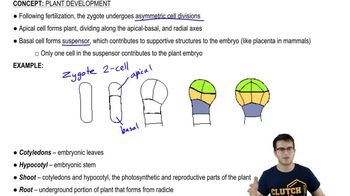
Understand that the zygote is formed by the fusion of two gametes (egg and sperm), resulting in a diploid (2n) cell, which will develop into the sporophyte.

Risposta video verificata per un problema simile:

Questa soluzione video è stata consigliata dai nostri tutor come utile per risolvere questo problema.
Durata del video:
26s

Concetti chiave

Ecco i concetti essenziali che devi comprendere per rispondere correttamente alla domanda.

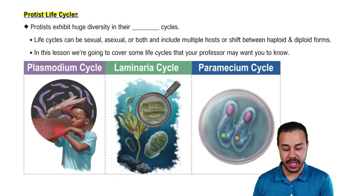
Angiosperm Life Cycle

Angiosperms, or flowering plants, have a life cycle that includes alternation of generations, involving both haploid (n) and diploid (2n) stages. The haploid stage includes gametes like eggs and spores, while the diploid stage includes the zygote and the mature plant. Understanding these stages is crucial for determining chromosome counts.
Video consigliato:
01:04
Protist Life Cycles

Chromosome Count in Plant Reproduction

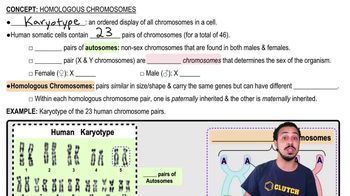
Chromosome count refers to the number of chromosomes present in a cell. In angiosperms, gametes such as eggs and microspores are haploid (n), containing one set of chromosomes, while the zygote is diploid (2n), formed by the fusion of two haploid gametes. This concept helps identify the correct pairing of reproductive structures with their chromosome counts.
Video consigliato:
08:09
Homologous Chromosomes

Megaspore Development

Megaspores are part of the female reproductive structure in angiosperms and are typically haploid (n), formed through meiosis. They develop into the female gametophyte, which produces the egg. The incorrect pairing in the question suggests a diploid (2n) count, which is not typical for megaspores, highlighting the importance of understanding their role and development.
Video consigliato:
06:02
Embryonic Plant Development