Ch. 33 - An introduction to Invertebrates
Campbell - Campbell Biology 11th Edition
Urry11th EditionCampbell BiologyISBN: 9789357423311Non è quello che usi tu?Cambia libro di testo
Capitolo 33, Problema 4

Which of the following combinations of phylum and description is incorrect?
a. Echinodermata—bilateral symmetry as a larva, coelomate
b. Nematoda—roundworms, pseudocoelomate
c. Platyhelminthes—flatworms, gastrovascular cavity, acoelomate
d. Porifera—gastrovascular cavity, coelomate

Guida verificata passo dopo passo
1
Understand the characteristics of each phylum mentioned in the options. This will help in identifying which description does not match the phylum.
Review the characteristics of Echinodermata. They are known for having bilateral symmetry as larvae and being coelomates, meaning they have a true coelom.
Examine the characteristics of Nematoda. These are roundworms and are pseudocoelomates, meaning they have a body cavity that is not completely lined by mesoderm.
Consider the characteristics of Platyhelminthes. These are flatworms, typically having a gastrovascular cavity and being acoelomates, meaning they lack a true coelom.
Analyze the characteristics of Porifera. They are sponges and do not have a gastrovascular cavity or a true coelom, which makes this combination incorrect.

Risposta video verificata per un problema simile:

Questa soluzione video è stata consigliata dai nostri tutor come utile per risolvere questo problema.
Durata del video:
57s

Concetti chiave

Ecco i concetti essenziali che devi comprendere per rispondere correttamente alla domanda.

Phylum Echinodermata

Echinodermata is a phylum of marine animals known for their radial symmetry in adulthood and bilateral symmetry as larvae. They are coelomates, meaning they have a true body cavity lined with mesoderm. Examples include starfish and sea urchins.
Video consigliato:
11:32
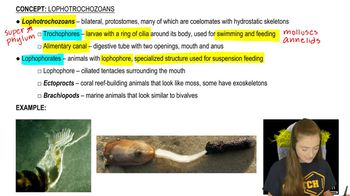
Lophotrochozoans

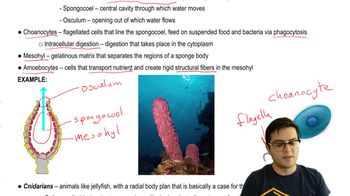
Phylum Porifera

Porifera, commonly known as sponges, are simple aquatic animals characterized by a porous body and lack of true tissues and organs. They do not possess a gastrovascular cavity or a coelom, as they have a simple body plan with a system of canals and chambers for water flow.
Video consigliato:
10:20
Porifera and Cnidaria

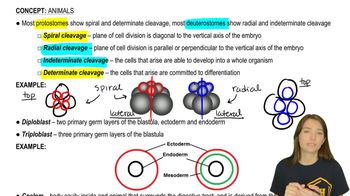
Body Cavities: Coelomate, Pseudocoelomate, Acoelomate

Body cavities are classified based on the presence and type of cavity. Coelomates have a true coelom lined with mesoderm, pseudocoelomates have a cavity not fully lined with mesoderm, and acoelomates lack a body cavity. These classifications help in understanding the complexity and organization of different animal phyla.
Video consigliato:
12:01
Overview of Animals - 3
Pratica correlata
Domanda del libro di testo

In the following figure, which two main clades branch from the most recent common ancestor of the eumetazoans?

a. Porifera and Cnidaria

b. Lophotrochozoa and Ecdysozoa

c. Cnidaria and Bilateria

d. Deuterostomia and Bilateria

<IMAGE>

1228
views
Domanda del libro di testo

The water vascular system of echinoderms

a. Functions as a circulatory system that distributes nutrients to body cells

b. Functions in locomotion and feeding

c. Is bilateral in organization, even though the adult animal is not bilaterally symmetrical

d. Moves water through the animal's body during filter feeding

2930
views
Domanda del libro di testo

Which phylum is characterized by animals that have a segmented body?

a. Cnidaria

b. Platyhelminthes

c. Arthropoda

d. Mollusca

1516
views
Domanda del libro di testo

A land snail, a clam, and an octopus all share

a. A mantle

b. A radula

c. Gills

d. Distinct cephalization

1010
views
Domanda del libro di testo

In Figure 33.7, assume that the two medusae shown at step 4 were produced by one polyp colony. Review Concept 12.1 and Concept 13.3, and then use your understanding of mitosis and meiosis to evaluate whether the following sentence is true or false; if false, select the answer that provides the correct reason. Although the two medusae are genetically identical, a sperm produced by one will differ genetically from an egg produced by the other.

<IMAGE>

a. Both the medusae and the gametes are genetically identical.

b. Neither the medusae nor the gametes are genetically identical.

c. The medusae are not genetically identical, but the gametes are genetically identical.

d. The medusae are genetically identical, but the gametes differ genetically.

836
views