
Ch. 34 - The Origin and Evolution of Vertebrates
Campbell - Campbell Biology 11th Edition
Urry11th EditionCampbell BiologyISBN: 9789357423311Non è quello che usi tu?Cambia libro di testo
Capitolo 34, Problema 1

Vertebrates and tunicates share
a. Jaws adapted for feeding
b. A high degree of cephalization
c. An endoskeleton that includes a skull
d. A notochord and a dorsal, hollow nerve cord

Guida verificata passo dopo passo
1
Understand the key characteristics of vertebrates and tunicates. Vertebrates are animals with a backbone, while tunicates are marine invertebrates that belong to the subphylum Tunicata within the phylum Chordata.
Identify the common features shared by all chordates, which include vertebrates and tunicates. These features are crucial for solving the problem.
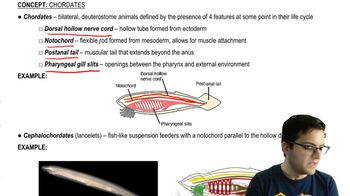
Recall that chordates typically possess a notochord, a dorsal hollow nerve cord, pharyngeal slits, and a post-anal tail at some stage in their life cycle.
Focus on the specific features mentioned in the problem: jaws, cephalization, endoskeleton, notochord, and nerve cord. Determine which of these are shared by both vertebrates and tunicates.
Conclude that the shared features between vertebrates and tunicates are the notochord and the dorsal, hollow nerve cord, as these are fundamental characteristics of all chordates.

Risposta video verificata per un problema simile:

Questa soluzione video è stata consigliata dai nostri tutor come utile per risolvere questo problema.
Durata del video:
49s

Concetti chiave

Ecco i concetti essenziali che devi comprendere per rispondere correttamente alla domanda.

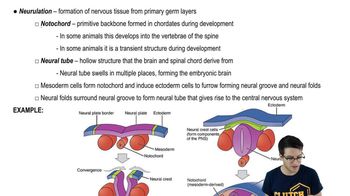
Notochord

The notochord is a flexible, rod-shaped structure found in the embryonic stage of all chordates, including vertebrates and tunicates. It provides skeletal support and is crucial for the development of the vertebral column in vertebrates. In tunicates, the notochord is present during the larval stage, aiding in swimming and structural support.
Video consigliato:
06:55
Organogenesis and Neurulation

Dorsal, Hollow Nerve Cord

The dorsal, hollow nerve cord is a key characteristic of chordates, running along the back of the organism. In vertebrates, it develops into the central nervous system, including the brain and spinal cord. Tunicates possess this feature during their larval stage, which is essential for transmitting nerve signals and coordinating movement.
Video consigliato:
05:34
Chordates

Chordate Characteristics

Chordates are defined by specific features such as a notochord, dorsal hollow nerve cord, pharyngeal slits, and a post-anal tail. These characteristics are present at some stage of development in all chordates, including vertebrates and tunicates, highlighting their evolutionary relationship and shared ancestry.
Video consigliato:
05:34
Chordates