Ch. 44 - Osmoregulation and Excretion
Campbell - Campbell Biology 11th Edition
Urry11th EditionCampbell BiologyISBN: 9789357423311Non è quello che usi tu?Cambia libro di testo
Capitolo 44, Problema 4

The high osmolarity of the renal medulla is maintained by all of the following except
a. Active transport of salt from the upper region of the ascending limb.
b. The spatial arrangement of juxtamedullary nephrons.
c. Diffusion of urea from the collecting duct.
d. Diffusion of salt from the descending limb of the loop of Henle.

Guida verificata passo dopo passo
1
Understand the role of the renal medulla: The renal medulla is responsible for concentrating urine, and its high osmolarity is crucial for this function.
Identify the mechanisms that contribute to high osmolarity: These include active transport of ions, diffusion of urea, and the unique arrangement of nephron structures.
Examine option a: Active transport of salt occurs in the ascending limb of the loop of Henle, contributing to the osmolarity gradient.
Examine option b: Juxtamedullary nephrons have long loops of Henle that extend deep into the medulla, aiding in the concentration of urine.
Examine option d: Salt does not diffuse from the descending limb; instead, water is reabsorbed here, increasing the concentration of the filtrate. This option does not contribute to the high osmolarity of the medulla.

Risposta video verificata per un problema simile:

Questa soluzione video è stata consigliata dai nostri tutor come utile per risolvere questo problema.
Durata del video:
46s

Concetti chiave

Ecco i concetti essenziali che devi comprendere per rispondere correttamente alla domanda.

Osmolarity in the Renal Medulla

Osmolarity refers to the concentration of solutes in a solution. In the renal medulla, high osmolarity is crucial for the kidney's ability to concentrate urine. This is achieved through the countercurrent multiplier system, which involves the loop of Henle and the vasa recta, creating a gradient that allows for water reabsorption and urine concentration.
Video consigliato:
07:59
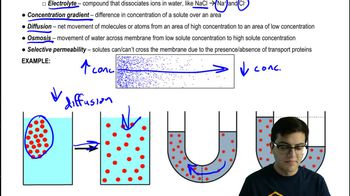
Osmosis and Osmolarity

Countercurrent Multiplier System

The countercurrent multiplier system is a mechanism in the kidneys that helps establish a concentration gradient in the renal medulla. It involves the loop of Henle, where the descending limb is permeable to water but not salt, and the ascending limb actively transports salt but is impermeable to water. This arrangement allows for the efficient reabsorption of water and solutes, maintaining high osmolarity.
Video consigliato:
06:28
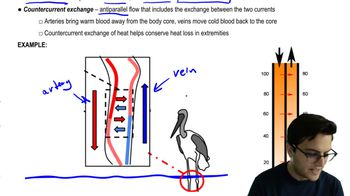
Countercurrent Exchange

Role of Urea in Osmolarity

Urea plays a significant role in maintaining the osmolarity of the renal medulla. It diffuses from the collecting duct into the medullary interstitium, contributing to the osmotic gradient. This process helps in the reabsorption of water from the collecting ducts, further concentrating the urine. Urea recycling is essential for sustaining the high osmolarity necessary for kidney function.
Video consigliato:
07:59
Osmosis and Osmolarity