
Ch. 45 - Hormones and the Endocrine System
Campbell - Campbell Biology 11th Edition
Urry11th EditionCampbell BiologyISBN: 9789357423311Non è quello che usi tu?Cambia libro di testo
Capitolo 45, Problema 1

Which of the following is not an accurate statement?
a. Hormones are chemical messengers that travel to target cells through the circulatory system.
b. Hormones often regulate homeostasis through antagonistic functions.
c. Hormones of the same chemical class usually have the same function.
d. Hormones are often regulated through feedback loops.

Guida verificata passo dopo passo
1
Identify the key characteristics of hormones: Hormones are chemical messengers that travel through the bloodstream to target cells, often regulating physiological processes.
Understand the concept of homeostasis: Hormones play a crucial role in maintaining homeostasis, often through antagonistic functions where two hormones have opposite effects to balance a physiological parameter.
Explore the concept of feedback loops: Hormones are typically regulated by feedback mechanisms, which can be either negative or positive, to maintain balance within the body.
Analyze the statement about chemical classes: Hormones of the same chemical class can have different functions, as their effects depend on the target cells and receptors they interact with.
Evaluate each statement: Compare each statement to the known characteristics of hormones to determine which one is inaccurate. Focus on the statement about chemical classes, as hormones of the same class do not necessarily have the same function.

Risposta video verificata per un problema simile:

Questa soluzione video è stata consigliata dai nostri tutor come utile per risolvere questo problema.
Durata del video:
55s

Concetti chiave

Ecco i concetti essenziali che devi comprendere per rispondere correttamente alla domanda.

Hormones as Chemical Messengers

Hormones are biochemical substances produced by glands in the endocrine system. They act as chemical messengers that travel through the bloodstream to target organs or cells, where they elicit specific physiological responses. This process is crucial for coordinating various bodily functions, including growth, metabolism, and reproduction.
Video consigliato:
01:56
Chemical Reactions

Homeostasis and Antagonistic Functions

Homeostasis refers to the body's ability to maintain a stable internal environment despite external changes. Hormones often regulate homeostasis through antagonistic functions, where pairs of hormones have opposite effects. For example, insulin and glucagon work antagonistically to regulate blood sugar levels, ensuring they remain within a narrow range.
Video consigliato:
11:49
Homeostasis

Hormone Feedback Loops

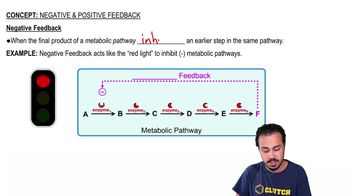
Feedback loops are mechanisms that regulate hormone levels in the body. Negative feedback loops are common, where an increase in hormone levels leads to actions that reduce its production, maintaining balance. For instance, the hypothalamus-pituitary-thyroid axis uses feedback loops to regulate thyroid hormone levels, ensuring metabolic processes function optimally.
Video consigliato:
02:41
Negative Feedback