
Ch. 8 - An Introduction to Metabolism
Campbell - Campbell Biology 11th Edition
Urry11th EditionCampbell BiologyISBN: 9789357423311Non è quello che usi tu?Cambia libro di testo
Capitolo 8, Problema 6

If an enzyme is added to a solution where its substrate and product are in equilibrium, what will occur?
a. Additional substrate will be formed.
b. The reaction will change from endergonic to exergonic.
c. The free energy of the system will change.
d. Nothing; the reaction will stay at equilibrium.

Guida verificata passo dopo passo
1
Understand the role of enzymes: Enzymes are biological catalysts that speed up the rate of a chemical reaction without being consumed in the process. They do not change the equilibrium position of a reaction.
Consider the concept of equilibrium: At equilibrium, the rate of the forward reaction equals the rate of the reverse reaction, and the concentrations of reactants and products remain constant over time.
Analyze the effect of adding an enzyme: Adding an enzyme to a reaction at equilibrium will increase the rate at which equilibrium is reached, but it will not change the concentrations of substrate and product at equilibrium.
Evaluate the options: Since enzymes do not alter the equilibrium position, they do not cause additional substrate to be formed, change the reaction from endergonic to exergonic, or alter the free energy of the system.
Conclude the outcome: The correct answer is that nothing will occur to change the equilibrium; the reaction will stay at equilibrium.

Risposta video verificata per un problema simile:

Questa soluzione video è stata consigliata dai nostri tutor come utile per risolvere questo problema.
Durata del video:
53s

Concetti chiave

Ecco i concetti essenziali che devi comprendere per rispondere correttamente alla domanda.

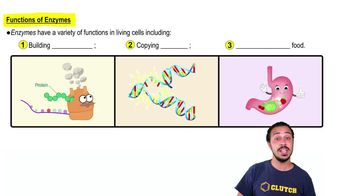
Enzyme Function

Enzymes are biological catalysts that speed up chemical reactions without being consumed. They lower the activation energy required for a reaction, allowing it to proceed faster. However, enzymes do not alter the equilibrium position of a reaction; they only help the system reach equilibrium more quickly.
Video consigliato:
02:32
Functions of Enzymes

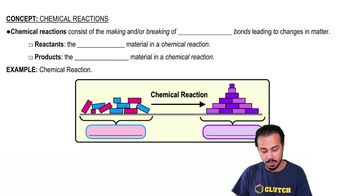
Chemical Equilibrium

Chemical equilibrium occurs when the rates of the forward and reverse reactions are equal, resulting in no net change in the concentrations of reactants and products. At equilibrium, the reaction is stable, and the addition of an enzyme does not shift the equilibrium position, but it can accelerate the attainment of equilibrium.
Video consigliato:
01:56
Chemical Reactions

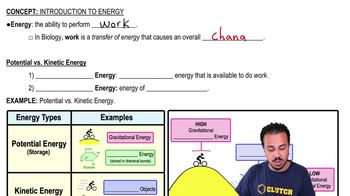
Free Energy

Free energy, specifically Gibbs free energy, is a thermodynamic quantity that indicates the amount of energy available to do work. In a reaction at equilibrium, the free energy change is zero, meaning no net energy is available to drive the reaction forward or backward. Enzymes do not change the free energy of a system; they only affect the rate at which equilibrium is reached.
Video consigliato:
04:58
Introduction to Energy