Explain why researchers formulate a null hypothesis in addition to a hypothesis when designing an experimental study.
Ch. 1 - Biology: The Study of Life
Freeman8th EditionBiological ScienceISBN: 9780138276263Non è quello che usi tu?Cambia libro di testo
Capitolo 1, Problema 6
What did Linnaeus' system of naming organisms ensure?
a. Two different organisms never end up with the same genus and species name.
b. Two different organisms have the same genus and species name if they are closely related.
c. The genus name is different for closely related species.
d. The species name is the same for each organism in a genus.
Guida verificata passo dopo passo1
Understand the concept of binomial nomenclature introduced by Carl Linnaeus, which is a formal system of naming species of living things by giving each a name composed of two parts.
The first part of the name is the genus, which is a group of related species. The second part is the specific epithet, which identifies the species within the genus.
Linnaeus' system ensures that each species has a unique combination of genus and species name, preventing confusion between different organisms.
The genus name is shared among species that are closely related, but the species name is unique to each organism within the genus.
Review the options given in the problem and identify which one correctly describes the purpose of Linnaeus' naming system, focusing on the uniqueness of the genus and species combination.

Risposta video verificata per un problema simile:
Questa soluzione video è stata consigliata dai nostri tutor come utile per risolvere questo problema.
Durata del video:
3mConcetti chiave
Ecco i concetti essenziali che devi comprendere per rispondere correttamente alla domanda.
Binomial Nomenclature
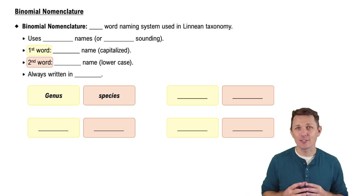
Binomial nomenclature is a formal system of naming species of living things by giving each a name composed of two parts, both of which use Latin grammatical forms. This system, developed by Carl Linnaeus, ensures that each species has a unique and universally accepted name, consisting of the genus name followed by the species name.
Video consigliato:
Percorso guidato
Binomial Nomenclature
Genus and Species
In biological classification, the genus is a rank used in the hierarchical classification of organisms, above species and below family. The species name is the second part of the binomial nomenclature and identifies the specific organism within the genus. This system prevents confusion by ensuring that no two species have the same genus and species name.
Video consigliato:
Percorso guidato
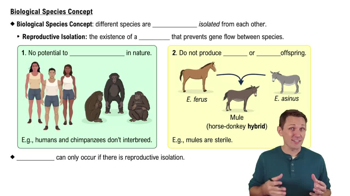
Biological Species Concept
Taxonomic Hierarchy
The taxonomic hierarchy is a system of classification that organizes living organisms into nested groups based on shared characteristics. It includes several ranks such as domain, kingdom, phylum, class, order, family, genus, and species. Linnaeus' system uses this hierarchy to ensure that closely related organisms are grouped under the same genus, while distinct species have unique names.
Video consigliato:
Life's Organizational Hierarchy
Pratica correlata
Domanda del libro di testo
1679
views
Domanda del libro di testo
A friend tells you that the theory of evolution is just an educated guess by biologists about how things work. Evaluate this statement.
749
views
Domanda del libro di testo
What would researchers have to demonstrate to convince you that they had discovered life on another planet?
1294
views
Domanda del libro di testo
What does it mean to say that a characteristic is heritable?
a. The characteristic evolves.
b. The characteristic can be passed on to offspring.
c. The characteristic is advantageous to the organism.
d. The characteristic does not vary in the population.
924
views
Domanda del libro di testo
Could both the food competition hypothesis and the sexual competition hypothesis explain why giraffes have long necks? Why or why not?
1132
views
Domanda del libro di testo
What is 'selected' during natural selection? Explain your answer.
1237
views