
Ch. 13 - Meiosis
Freeman - Biological Science 8th Edition
Freeman8th EditionBiological ScienceISBN: 9780138276263Non è quello che usi tu?Cambia libro di testo
Capitolo 13, Problema 4

Nondisjunction that leads to problems in offspring can occur in:
a. Mitosis
b. Meiosis I only
c. Meiosis I and II
d. Mitosis, meiosis I, and meiosis II

Guida verificata passo dopo passo
1
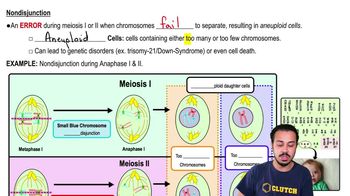
Understand the concept of nondisjunction: Nondisjunction is the failure of homologous chromosomes or sister chromatids to separate properly during cell division, leading to an abnormal number of chromosomes in the daughter cells.
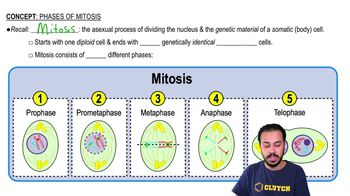
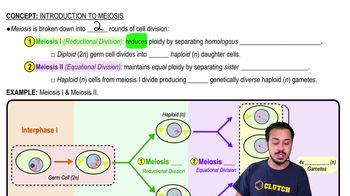
Identify the types of cell division: Mitosis is the process of cell division that results in two identical daughter cells, while meiosis is the process that results in four genetically diverse daughter cells, each with half the number of chromosomes of the parent cell.
Recognize where nondisjunction can occur: Nondisjunction can occur during both mitosis and meiosis. In meiosis, it can happen during meiosis I, where homologous chromosomes fail to separate, or during meiosis II, where sister chromatids fail to separate.
Consider the implications of nondisjunction in meiosis: Nondisjunction during meiosis can lead to gametes with an abnormal number of chromosomes, which can result in disorders such as Down syndrome when these gametes are involved in fertilization.
Evaluate the options given in the problem: Analyze each option to determine where nondisjunction can occur, considering the processes of mitosis, meiosis I, and meiosis II.

Risposta video verificata per un problema simile:

Questa soluzione video è stata consigliata dai nostri tutor come utile per risolvere questo problema.
Durata del video:
3m

Concetti chiave

Ecco i concetti essenziali che devi comprendere per rispondere correttamente alla domanda.

Nondisjunction

Nondisjunction is a chromosomal error that occurs when homologous chromosomes or sister chromatids fail to separate properly during cell division. This results in gametes or cells with an abnormal number of chromosomes, which can lead to genetic disorders in offspring, such as Down syndrome or Turner syndrome.
Video consigliato:
05:03
Nondisjunction

Mitosis

Mitosis is the process of cell division that results in two genetically identical daughter cells, each with the same number of chromosomes as the parent cell. It is primarily involved in growth, repair, and asexual reproduction. Nondisjunction in mitosis can lead to mosaicism, where some cells have different genetic makeup within the same organism.
Video consigliato:
03:21
Phases of Mitosis

Meiosis

Meiosis is a specialized form of cell division that reduces the chromosome number by half, producing four genetically diverse gametes. It consists of two stages: meiosis I, where homologous chromosomes separate, and meiosis II, where sister chromatids separate. Nondisjunction can occur in either stage, leading to gametes with an abnormal number of chromosomes, affecting offspring.
Video consigliato:
04:49
Meiosis I & Meiosis II
Pratica correlata
Domanda del libro di testo

What is an outcome of genetic recombination?

a. The synapsing of homologs during prophase of meiosis I

b. The new combination of maternal and paternal chromosome segments that results when homologs cross over

c. The new combinations of chromosome segments that result when self-fertilization occurs

d. The combination of a haploid phase and a diploid phase in a life cycle

1084
views
Domanda del libro di testo

What are homologous chromosomes?

a. Chromosomes that are similar in their size, shape, and gene content

b. Similar chromosomes that are found in different individuals of the same species

c. The two chromatids in a replicated chromosome

d. Any chromosome in a diploid cell

1958
views
Domanda del libro di testo

Norway rats have 42 chromosomes in their diploid cells. If such a cell enters meiosis, how many chromosomes and double-helical molecules of DNA will be present in each daughter cell at the end of meiosis II?

a. 21 chromosomes and 21 double-helical DNA molecules

b. 21 chromosomes and 42 double-helical DNA molecules

c. 42 chromosomes and 42 double-helical DNA molecules

d. 42 chromosomes and 84 double-helical DNA molecules

497
views
Domanda del libro di testo

If you followed a woman's cells through meiosis, at what stage of meiosis would the amount of DNA in one of these cells be equal to the amount of DNA in one of her G1 phase (before DNA replication) kidney cells?

987
views
Domanda del libro di testo

Select True or False for each statement.

Sister chromatids are homologous chromosomes.

Non-sister chromatids are found on two different homologs.

Crossing over occurs between sister chromatids.

A chiasma forms between two of the four molecules of double-stranded DNA on duplicated homologous chromosomes.

1165
views
Domanda del libro di testo

What proportion of chromosomes in a man's skin cell are maternal chromosomes?

1327
views