
Ch. 14 - Mendel and the Gene
Freeman - Biological Science 8th Edition
Freeman8th EditionBiological ScienceISBN: 9780138276263Non è quello che usi tu?Cambia libro di testo
Capitolo 14, Problema 1

The genes for the traits that Mendel worked with are either all located on different chromosomes or behave as if they were. How did this help Mendel recognize the principle of independent assortment?
a. Otherwise, his dihybrid crosses would not have produced a 9 : 3 : 3 : 1 ratio of F2 phenotypes.
b. The occurrence of individuals with unexpected phenotypes led him to the discovery of recombination.
c. It led him to the realization that the behavior of chromosomes during meiosis explained his results.
d. It meant that the alleles involved were either dominant or recessive, which gave 3 : 1 ratios in the F1 generation.

Guida verificata passo dopo passo
1
Step 1: Understand Mendel's principle of independent assortment, which states that alleles for different traits are distributed to sex cells (& gametes) independently of one another.
Step 2: Recognize that Mendel's experiments involved dihybrid crosses, where he observed the inheritance of two different traits simultaneously.
Step 3: Consider the genetic basis of Mendel's observations. If the genes for the traits were located on different chromosomes, they would assort independently during meiosis, leading to the expected phenotypic ratios.
Step 4: Analyze the expected phenotypic ratio of 9:3:3:1 in the F2 generation of a dihybrid cross, which supports the principle of independent assortment. This ratio occurs when alleles segregate independently.
Step 5: Evaluate the options given in the problem. Option 'a' directly relates to the expected 9:3:3:1 ratio, which is a result of independent assortment, helping Mendel recognize this principle.

Risposta video verificata per un problema simile:

Questa soluzione video è stata consigliata dai nostri tutor come utile per risolvere questo problema.
Durata del video:
2m

Concetti chiave

Ecco i concetti essenziali che devi comprendere per rispondere correttamente alla domanda.

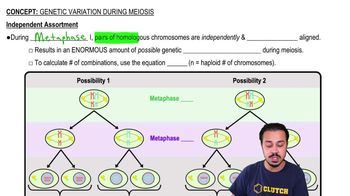
Independent Assortment

Independent assortment is a principle of genetics discovered by Gregor Mendel, stating that genes for different traits can segregate independently during the formation of gametes. This means that the inheritance of one trait generally does not affect the inheritance of another, allowing for genetic variation. Mendel observed this through his dihybrid crosses, which produced a 9:3:3:1 ratio in the F2 generation, supporting the idea that alleles of different genes are distributed independently.
Video consigliato:
08:49
Independent Assortment

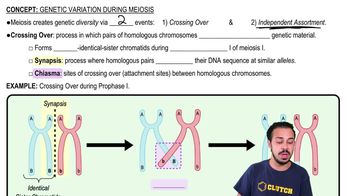
Chromosome Behavior During Meiosis

During meiosis, homologous chromosomes pair up and then separate into different gametes, which explains Mendel's observations of independent assortment. This process ensures that each gamete receives a random assortment of maternal and paternal chromosomes, contributing to genetic diversity. Mendel's realization that chromosome behavior during meiosis explained his results was crucial in understanding how traits are inherited independently.
Video consigliato:
07:08
Genetic Variation During Meiosis

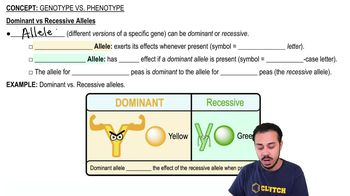
Dominant and Recessive Alleles

Dominant and recessive alleles are key concepts in Mendelian genetics, where dominant alleles mask the expression of recessive ones in heterozygous individuals. This results in a 3:1 phenotypic ratio in the F1 generation when crossing homozygous dominant and recessive parents. Mendel's experiments with pea plants demonstrated these predictable patterns of inheritance, which helped him formulate the laws of inheritance, including the principle of independent assortment.
Video consigliato:
03:39
Dominant vs. Recessive Alleles