
Ch. 17 - Transcription, RNA Processing, and Translation
Freeman - Biological Science 8th Edition
Freeman8th EditionBiological ScienceISBN: 9780138276263Non è quello che usi tu?Cambia libro di testo
Capitolo 17, Problema 3

Splicing begins:
a. As transcription occurs.
b. After transcription is complete.
c. As translation occurs.
d. After translation is complete.

Guida verificata passo dopo passo
1
Understand the concept of splicing: Splicing is a process in eukaryotic cells where introns (non-coding regions) are removed from the pre-mRNA, and exons (coding regions) are joined together to form mature mRNA.
Recall the sequence of events in gene expression: Transcription occurs first, where DNA is transcribed into pre-mRNA. Splicing happens to process the pre-mRNA into mature mRNA, which is then translated into a protein.
Identify the timing of splicing: Splicing occurs in the nucleus and is closely associated with transcription. In some cases, splicing can begin while transcription is still ongoing, a process known as co-transcriptional splicing.
Eliminate incorrect options: Splicing does not occur during translation or after translation is complete, as translation happens in the cytoplasm and requires mature mRNA. Therefore, options c and d can be ruled out.
Focus on the correct timing: Splicing can occur as transcription is happening (co-transcriptionally) or after transcription is complete, depending on the organism and specific gene being expressed. Both options a and b are relevant, but the emphasis is often on co-transcriptional splicing.

Risposta video verificata per un problema simile:

Questa soluzione video è stata consigliata dai nostri tutor come utile per risolvere questo problema.
Durata del video:
40s

Concetti chiave

Ecco i concetti essenziali che devi comprendere per rispondere correttamente alla domanda.

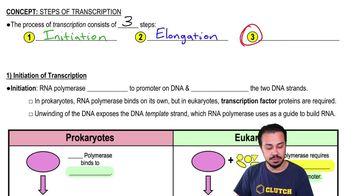
Transcription

Transcription is the process by which the genetic information encoded in DNA is copied into messenger RNA (mRNA). This occurs in the nucleus of eukaryotic cells and involves the enzyme RNA polymerase, which synthesizes the mRNA strand complementary to the DNA template. Understanding transcription is crucial as it sets the stage for subsequent processes like splicing and translation.
Video consigliato:
04:16
1) Initiation of Transcription

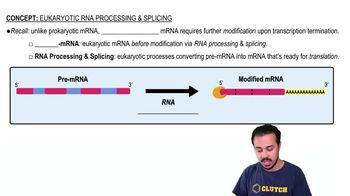
RNA Splicing

RNA splicing is a post-transcriptional modification where introns (non-coding regions) are removed from the pre-mRNA transcript, and exons (coding regions) are joined together. This process is essential for producing a mature mRNA molecule that can be translated into a protein. Splicing can occur co-transcriptionally, meaning it can begin while transcription is still ongoing, which is key to answering the question.
Video consigliato:
02:32
Eukaryotic RNA Processing and Splicing

Translation

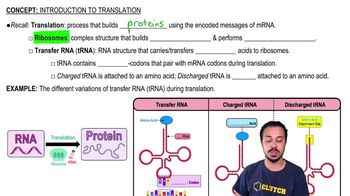
Translation is the process by which the mRNA sequence is decoded to synthesize proteins, occurring in the ribosome. This process follows splicing and involves the assembly of amino acids into a polypeptide chain based on the sequence of codons in the mRNA. Understanding the timing of translation relative to transcription and splicing is important for grasping the overall flow of genetic information.
Video consigliato:
06:12
Introduction to Translation
Pratica correlata
Domanda del libro di testo

For each of these statements about the genetic code, select True or False.

a. T/F Wobble pairing accounts for the redundancy of the genetic code.

b. T/F There are 64 different tRNAs that read the 64 possible codons.

c. T/F All possible codons are used, but not all codons specify an amino acid.

d. T/F Some codons are recognized by proteins, not by tRNAs.

1486
views
Domanda del libro di testo

What does a bacterial RNA polymerase produce when it transcribes a protein-coding gene?

a. rRNA

b. tRNA

c. mRNA

d. snRNA

1697
views
Domanda del libro di testo

Where is the start codon located?

a. At the start (5′ end) of the mRNA

b. In the DNA just upstream of where transcription starts

c. At the downstream end of the 5′ untranslated region (UTR)

d. At the upstream end of the 3′ untranslated region (UTR)

3111
views
Domanda del libro di testo

Compared with mRNAs that have a cap and tail, predict what will be observed if a eukaryotic mRNA lacked a cap and poly(A) tail.

a. The primary transcript would not be processed properly.

b. Translation would occur inefficiently.

c. Enzymes on the ribosome would add a cap and poly(A) tail.

d. tRNAs would become more resistant to degradation.

1247
views
Domanda del libro di testo

RNases and proteases are enzymes that destroy RNAs and proteins, respectively. Which of the following enzymes, if added to a spliceosome, would be predicted to prevent recognition of pre-mRNA regions critical for splicing?

a. An RNase specific for tRNAs

b. An RNase specific for snRNAs

c. A protease specific for initiation factors

d. A protease specific for a release factor

1158
views