
Ch. 19 - Control of Gene Expression in Eukaryotes
Freeman - Biological Science 8th Edition
Freeman8th EditionBiological ScienceISBN: 9780138276263Non è quello che usi tu?Cambia libro di testo
Capitolo 19, Problema 1

What is chromatin?
a. The histone-containing protein core of the nucleosome
b. The 30-nm fiber
c. The complex of DNA and proteins found in the nucleus
d. The histone and non-histone proteins in eukaryotic nuclei

Guida verificata passo dopo passo
1
Understand the term 'chromatin': Chromatin is a complex of DNA and proteins found in the nucleus of eukaryotic cells. It plays a crucial role in packaging the DNA into a more compact form, allowing it to fit within the nucleus.
Identify the components of chromatin: Chromatin consists of DNA wrapped around histone proteins, forming structures known as nucleosomes. These nucleosomes further coil and fold to form higher-order structures, such as the 30-nm fiber.
Differentiate between histone and non-histone proteins: Histone proteins are the main protein components of chromatin, responsible for DNA packaging. Non-histone proteins are involved in regulating gene expression and maintaining chromatin structure.
Consider the options provided: Evaluate each option to determine which best describes chromatin. Option c, 'the complex of DNA and proteins found in the nucleus,' accurately captures the definition of chromatin.
Conclude with the correct choice: Based on the understanding of chromatin, select option c as the correct answer, as it encompasses the essential components and function of chromatin in the nucleus.

Risposta video verificata per un problema simile:

Questa soluzione video è stata consigliata dai nostri tutor come utile per risolvere questo problema.
Durata del video:
1m

Concetti chiave

Ecco i concetti essenziali che devi comprendere per rispondere correttamente alla domanda.

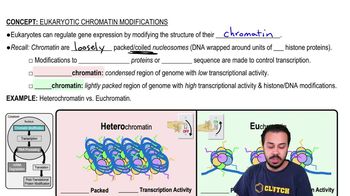
Chromatin

Chromatin is the complex of DNA and proteins found in the nucleus of eukaryotic cells. It serves to efficiently package DNA into a small volume to fit into the nucleus and protect the DNA structure and sequence. Chromatin is composed of histone proteins around which DNA is wrapped, forming nucleosomes, and non-histone proteins that regulate gene expression and DNA replication.
Video consigliato:
03:55
Eukaryotic Chromatin Modifications

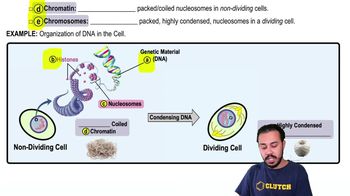
Nucleosome

A nucleosome is the basic structural unit of chromatin, consisting of a segment of DNA wound around a core of histone proteins. This structure helps in organizing the DNA into a compact form, making it accessible for processes like transcription and replication. Nucleosomes are linked by DNA strands, forming a 'beads on a string' appearance under a microscope.
Video consigliato:
06:52
Organization of DNA in the Cell

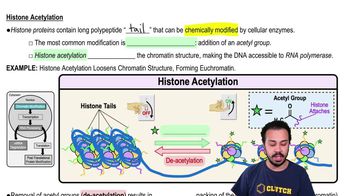
Histone Proteins

Histone proteins are essential components of chromatin, acting as spools around which DNA winds. They play a critical role in gene regulation by undergoing chemical modifications that can either promote or inhibit the transcription of genes. Histones help maintain the structure of chromatin and are involved in the regulation of DNA replication and repair.
Video consigliato:
04:14
Histone Acetylation