
Ch. 2 - Water and Carbon: The Chemical Basis of Life
Freeman - Biological Science 8th Edition
Freeman8th EditionBiological ScienceISBN: 9780138276263Non è quello che usi tu?Cambia libro di testo
Capitolo 2, Problema 10

From what you have learned about water, why do coastal regions tend to have milder climates with cooler summers and warmer winters than do inland areas at the same latitude?

Guida verificata passo dopo passo
1
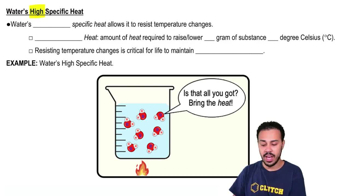
Understand the properties of water: Water has a high specific heat capacity, which means it can absorb or release a large amount of heat energy with only a slight change in temperature.
Relate the property to climate: Because of its high specific heat, large bodies of water like oceans can absorb heat from the atmosphere in summer, keeping coastal regions cooler.
Consider winter temperatures: In winter, the water slowly releases the stored heat, which helps to warm the air in coastal regions, leading to milder winter temperatures compared to inland areas.
Compare with inland areas: Inland areas, lacking the moderating influence of large water bodies, experience more extreme temperatures because the land heats up and cools down more quickly than water.
Summarize the influence on climate: The ability of water to moderate temperature influences the climate of coastal regions, making them have milder climates with cooler summers and warmer winters compared to inland areas at the same latitude.

Risposta video verificata per un problema simile:

Questa soluzione video è stata consigliata dai nostri tutor come utile per risolvere questo problema.
Durata del video:
44s

Concetti chiave

Ecco i concetti essenziali che devi comprendere per rispondere correttamente alla domanda.

Specific Heat Capacity

Water has a high specific heat capacity, meaning it can absorb and store large amounts of heat without a significant change in temperature. This property allows coastal regions to moderate temperature fluctuations, resulting in cooler summers and warmer winters compared to inland areas, which experience more extreme temperature changes.
Video consigliato:
03:25
Water’s High Specific Heat

Ocean Currents

Ocean currents play a crucial role in regulating climate by redistributing heat across the planet. Warm currents can raise temperatures in coastal areas, while cold currents can have a cooling effect. These currents help maintain milder temperatures in coastal regions, contributing to their distinct climate patterns.
Video consigliato:
03:54
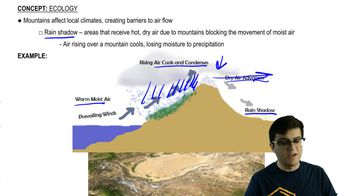
Mountains and Air Currents

Humidity and Precipitation

Coastal regions typically have higher humidity levels due to the proximity of large bodies of water. This increased moisture can lead to more cloud cover and precipitation, which further moderates temperature extremes. The presence of humidity helps to keep coastal areas cooler in summer and warmer in winter compared to drier inland regions.
Video consigliato:
05:02
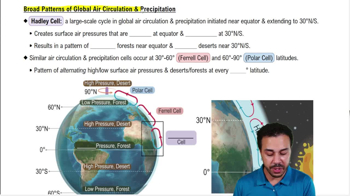
Broad Patterns of Global Air Circulation & Precipitation
Pratica correlata
Domanda del libro di testo

Consider the reaction between carbon dioxide and water to form carbonic acid: CO2(g)+H2O(l)⇌CH2O3(aq) In the ocean, carbonic acid immediately dissociates to form a proton and bicarbonate ion, as follows: CH2O3(aq)+H+(aq)⇌CHO3−(aq) If an underwater volcano bubbled additional CO2 into the ocean, would this sequence of reactions be driven to the left or the right? How would this affect the pH of the ocean?

2531
views
Domanda del libro di testo

Consider the reaction between carbon dioxide and water to form carbonic acid (CH2O3):


CO2(𝑔)+H2O(𝑙)⇌CH2O3(𝑎𝑞)


In the ocean, carbonic acid immediately dissociates to form a proton and bicarbonate ion, as follows:


CH2O3(𝑎𝑞)⇌CHO3−(𝑎𝑞)+H+(𝑎𝑞)


As atmospheric CO2 increases, the ocean absorbs more of the gas. Would this sequence of reactions be driven to the left or the right? How would this affect the pH of the ocean?

378
views
Domanda del libro di testo

When H2 and CO2 react, acetic acid can be formed spontaneously while the production of formaldehyde requires an input of energy. Which of these conclusions can be drawn from this observation?

a. More heat is released when formaldehyde is produced compared to the production of acetic acid.

b. Compared to the reactants that it is formed from, formaldehyde has more potential energy than does acetic acid.

c. Entropy decreases when acetic acid is produced and increases when formaldehyde is produced.

d. Only acetic acid could be produced under conditions that existed in early Earth.

1981
views
Domanda del libro di testo

If you were given a solution that has a pH of 8.5, what would be its concentration of protons? What is the difference in proton concentration between this solution and one that has a pH of 7?

3669
views