Ch. 21 - Genes, Development, and Evolution
Freeman - Biological Science 8th Edition
Freeman8th EditionBiological ScienceISBN: 9780138276263Non è quello che usi tu?Cambia libro di testo
Capitolo 21, Problema 3

What is a homeotic mutant?
a. An individual with a structure located in the wrong place
b. An individual with an abnormal head-to-tail axis
c. An individual that is missing segments
d. An individual with double the normal number of structures

Guida verificata passo dopo passo
1
Understand the term 'homeotic mutant': A homeotic mutant refers to an organism in which a body part or structure develops in the wrong location due to mutations in homeotic genes, which are responsible for determining the identity of body segments during development.
Review the role of homeotic genes: These genes, such as Hox genes, are critical in specifying the identity of body regions along the anterior-posterior axis. Mutations in these genes can cause structures to form in inappropriate locations.
Analyze the options provided: a) An individual with a structure located in the wrong place, b) An individual with an abnormal head-to-tail axis, c) An individual that is missing segments, d) An individual with double the normal number of structures.
Eliminate incorrect options: Options b, c, and d describe other types of developmental abnormalities, such as axis formation defects, segmentation issues, or duplication of structures, which are not specific to homeotic mutations.
Conclude that the correct answer is option a: A homeotic mutant is characterized by a structure being located in the wrong place, which directly aligns with the definition of a homeotic mutation.

Risposta video verificata per un problema simile:

Questa soluzione video è stata consigliata dai nostri tutor come utile per risolvere questo problema.
Durata del video:
3m

Concetti chiave

Ecco i concetti essenziali che devi comprendere per rispondere correttamente alla domanda.

Homeotic Genes

Homeotic genes are a group of regulatory genes that control the development of anatomical structures in various organisms. They play a crucial role in determining the identity of body segments during embryonic development. Mutations in these genes can lead to the misplacement of body parts, resulting in homeotic mutants.
Video consigliato:
05:02
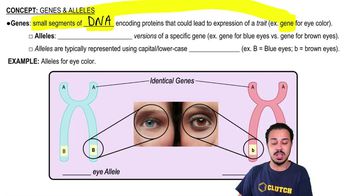
Genes & Alleles

Mutations and Developmental Biology

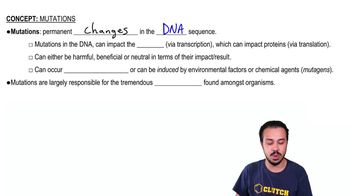
In developmental biology, mutations refer to changes in the DNA sequence that can affect an organism's development. Homeotic mutations specifically alter the normal pattern of body structure formation, leading to abnormalities such as the presence of body parts in incorrect locations, which is a hallmark of homeotic mutants.
Video consigliato:
02:29
Mutations

Phenotypic Expression

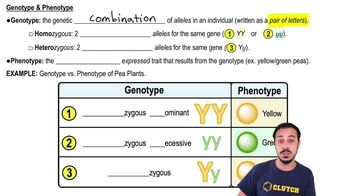
Phenotypic expression refers to the observable traits or characteristics of an organism resulting from the interaction of its genotype with the environment. In the context of homeotic mutants, the phenotypic expression manifests as structural anomalies, such as limbs or organs appearing in inappropriate locations, highlighting the impact of genetic regulation on physical form.
Video consigliato:
06:36
Genotype & Phenotype
Pratica correlata
Domanda del libro di testo

What is apoptosis?

a. An experimental technique used to kill specific cells

b. Programmed cell death that is required for normal development

c. A pathological condition observed only in damaged or diseased organisms

d. A developmental mechanism unique to the roundworm C. elegans

1369
views
Domanda del libro di testo

In adult animals, ___________ are a source of undifferentiated cells that can divide to produce cells that can specialize.

591
views
Domanda del libro di testo

A tool-kit gene is               .

769
views
Domanda del libro di testo

The following predictions ask you to consider how genetic regulatory cascades provide positional information. Select True or False for each statement.

T/F Mutation of a gene at one level of a regulatory cascade will affect the expression of genes at all levels of the cascade.

T/F Mutation of a gene that is expressed later in a regulatory cascade will affect a smaller region of the body than mutation of gene that is expressed early in the cascade.

T/F In the regulatory cascade used by Drosophila, a gene at one level of the cascade will be controlled only by genes at the level immediately above it.

T/F Genes that control the largest regions of the Drosophila embryo are not transcribed in the embryo.

667
views
Domanda del libro di testo

A friend is interested in isolating genes that are expressed solely in liver cells but only has access to skin cells. She asks you for advice on whether to start her studies. What will you say?

591
views