Ch. 23 - Evolutionary Processes
Freeman - Biological Science 8th Edition
Freeman8th EditionBiological ScienceISBN: 9780138276263Non è quello che usi tu?Cambia libro di testo
Capitolo 23, Problema 5

In a population of 2500, how many babies would you expect to have cystic fibrosis, a homozygous recessive condition, if the frequency of the dominant allele is 0.9 and the population is at Hardy–Weinberg equilibrium?
a. 0.9 × 2500 = 2250
b. 2 × 0.9 × 0.1 × 2500 = 450
c. 0.9 × 0.1 × 2500 = 225
d. 0.1 x 0.1 x 2500 = 25

Guida verificata passo dopo passo
1
Understand that cystic fibrosis is a homozygous recessive condition, which means individuals with the condition have two recessive alleles (cc).
Recall the Hardy-Weinberg principle, which states that allele and genotype frequencies in a population will remain constant from generation to generation in the absence of evolutionary influences.
Identify the frequency of the recessive allele (c) using the given frequency of the dominant allele (C). If the frequency of the dominant allele (C) is 0.9, then the frequency of the recessive allele (c) is 1 - 0.9 = 0.1.
Calculate the expected frequency of individuals with cystic fibrosis (cc) using the formula for homozygous recessive genotype frequency: \( q^2 \), where \( q \) is the frequency of the recessive allele. Thus, \( q^2 = 0.1^2 \).
Multiply the frequency of the homozygous recessive genotype (\( q^2 \)) by the total population size to find the expected number of individuals with cystic fibrosis: \( 0.1^2 \times 2500 \).

Risposta video verificata per un problema simile:

Questa soluzione video è stata consigliata dai nostri tutor come utile per risolvere questo problema.
Durata del video:
2m

Concetti chiave

Ecco i concetti essenziali che devi comprendere per rispondere correttamente alla domanda.

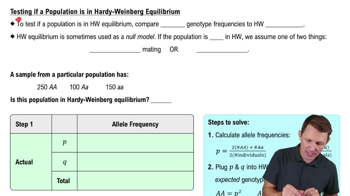
Hardy-Weinberg Equilibrium

The Hardy-Weinberg equilibrium is a principle that describes a stable genetic state in a population where allele and genotype frequencies remain constant across generations, provided no evolutionary influences occur. It assumes random mating, no mutation, migration, or selection, and large population size. This model helps predict genotype frequencies using allele frequencies.
Video consigliato:
Percorso guidato
08:26
Testing if a Population is in Hardy-Weinberg Equilibrium

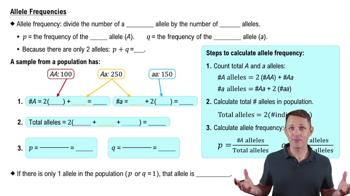
Allele Frequency

Allele frequency refers to how often an allele appears in a population's gene pool. It is expressed as a proportion or percentage of the total alleles for a particular gene. In the context of Hardy-Weinberg equilibrium, allele frequencies are used to calculate expected genotype frequencies, such as homozygous recessive conditions like cystic fibrosis.
Video consigliato:
Percorso guidato
06:36
Allele Frequencies

Homozygous Recessive Condition

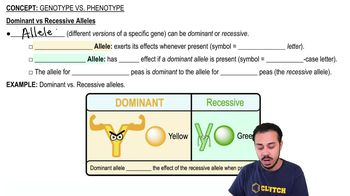
A homozygous recessive condition occurs when an individual has two copies of a recessive allele, resulting in the expression of a recessive trait or disorder. For cystic fibrosis, individuals must inherit two recessive alleles (cc) to exhibit the condition. Calculating the frequency of such individuals involves squaring the frequency of the recessive allele under Hardy-Weinberg equilibrium.
Video consigliato:
03:39
Dominant vs. Recessive Alleles