Ch. 23 - Evolutionary Processes
Freeman - Biological Science 8th Edition
Freeman8th EditionBiological ScienceISBN: 9780138276263Non è quello che usi tu?Cambia libro di testo
Capitolo 23, Problema 11

Suppose you were a conservation biologist working to preserve two populations of monkeys. The first population has 5000 individuals, while the second population has 50,000 individuals. Which population do you expect to have higher genetic diversity? Consider which evolutionary process(es) may be different between these populations. Justify your response.

Guida verificata passo dopo passo
1
Consider the size of each population. Generally, larger populations have more opportunities for mutations and genetic recombination, which are key sources of genetic diversity.
Reflect on the impact of genetic drift, which is more pronounced in smaller populations. Genetic drift can lead to a more rapid loss of genetic variation in smaller populations compared to larger ones.
Think about the founder effect and bottleneck events. If either population has experienced such events, it could significantly affect their genetic diversity. Smaller populations are typically more susceptible to drastic changes in genetic diversity due to these events.
Evaluate the potential for gene flow in each population. Populations with more connections to other groups (e.g., through migration) can have higher genetic diversity. Isolation can reduce genetic diversity.
Assess the overall environmental and ecological factors that might influence each population differently, such as different selective pressures or habitat fragmentation, which could influence the genetic diversity observed in each population.

Risposta video verificata per un problema simile:

Questa soluzione video è stata consigliata dai nostri tutor come utile per risolvere questo problema.
Durata del video:
1m

Concetti chiave

Ecco i concetti essenziali che devi comprendere per rispondere correttamente alla domanda.

Genetic Diversity

Genetic diversity refers to the total number of genetic characteristics in the genetic makeup of a species. It is crucial for the adaptability and survival of populations, as higher genetic diversity increases the likelihood of individuals possessing traits that can withstand environmental changes and diseases. In conservation biology, maintaining genetic diversity is essential for the long-term viability of species.
Video consigliato:
Percorso guidato
02:37
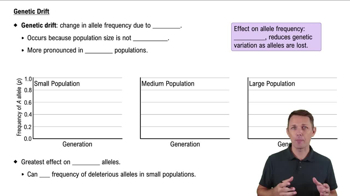
Genetic Drift Example 2

Population Size and Genetic Drift

Population size significantly influences genetic diversity through a process known as genetic drift, which is the random fluctuation of allele frequencies in a population. In smaller populations, genetic drift can lead to the loss of alleles and reduced genetic variation over time, making them more vulnerable to extinction. Conversely, larger populations tend to maintain higher levels of genetic diversity due to a greater pool of alleles.
Video consigliato:

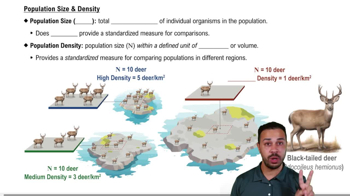
Effective Population Size

Effective population size (Ne) is a measure of the number of individuals in a population that contribute to the next generation's gene pool. It often differs from the actual population size due to factors like unequal sex ratios, variation in reproductive success, and fluctuations in population size. A higher effective population size generally correlates with greater genetic diversity, as it reflects the number of individuals that can pass on their genes.
Video consigliato:
01:52
Population Size & Density
Pratica correlata
Domanda del libro di testo

In humans, albinism is caused by loss-of-function mutations in genes involved in the synthesis of melanin, the dark pigment in skin. Only people homozygous for a loss-of-function allele (genotype 𝑎𝑎) have albinism. In one study of an American population, individuals with albinism were present at a frequency of about 1 in 10,000 (or 0.0001). Assuming that genotypes are in Hardy–Weinberg Equilibrium, what is the predicted frequency of individuals who are carriers (that is, 𝐴𝑎) for the albinism allele?

410
views
Domanda del libro di testo

Draw a small concept map showing how selection, genetic drift, gene flow, and mutation relate to genetic variation.

1060
views
Domanda del libro di testo

Human activities are causing the fragmentation of the Brazilian Atlantic rain forest. One result is that toucans have become extinct or nearly extinct in some of the forest fragments. Does the absence of toucans affect the forest?

Toucans disperse seeds of key forest species such as juçara palms by eating the fruit and defecating the seeds in new locations, sometimes more than a kilometer away. If there are no toucans, is the genetic diversity of palms likely to increase or decrease within forest fragments? Why?

a. Increase (due to increased genetic drift)

b. Decrease (due to decreased gene flow)

c. Decrease (due to decreased mutation rate)

d. Decrease (due to decreased natural selection)

740
views
Domanda del libro di testo

Human activities are causing the fragmentation of the Brazilian Atlantic rain forest. One result is that toucans have become extinct or nearly extinct in some of the forest fragments. Does the absence of toucans affect the forest? Toucans can eat fruits with large seeds because their large bills can open wide. Most other birds in the same forest can only eat small seeds. Ecologist Mauro Galetti and his colleagues measured the seed sizes of palms in forest fragments with and without toucans. The graphs show two of the forest populations they studied. What is the take-home message of the data?

737
views