
Ch. 24 - Speciation
Freeman - Biological Science 8th Edition
Freeman8th EditionBiological ScienceISBN: 9780138276263Non è quello che usi tu?Cambia libro di testo
Capitolo 24, Problema 6

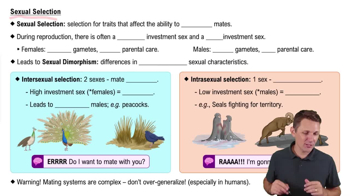
Sexual selection favors individuals with traits that increase their ability to obtain mates, such as mating calls in crickets. Using this example, propose a scenario where sexual selection could contribute to divergence in sympatric speciation.

Guida verificata passo dopo passo
1
Identify the initial population and the trait under consideration: Start by considering a population of crickets that are initially similar but have variations in their mating calls. These variations could be in pitch, duration, or frequency of the calls.
Introduce a selective pressure: Propose a scenario where females in the population begin to prefer a specific type of mating call. This preference could be influenced by environmental factors such as predation, where perhaps a lower pitch is less detectable by predators.
Genetic divergence begins: As females preferentially choose males with the favored mating call, those males reproduce more successfully. Over generations, the genes associated with the preferred call increase in frequency within the population, leading to genetic divergence.
Reproductive isolation occurs: As the preference for the specific mating call strengthens, males with different calls have reduced mating success. This reproductive isolation can be further enhanced if the females' auditory receptors co-evolve to become more sensitive to the preferred call frequency, making other calls less attractive or even unrecognizable.
Speciation completes: Eventually, the differences in mating calls and possibly other co-evolved traits lead to complete reproductive isolation. Despite living in the same geographic area (sympatric), the two groups no longer interbreed and thus become separate species through sexual selection.

Risposta video verificata per un problema simile:

Questa soluzione video è stata consigliata dai nostri tutor come utile per risolvere questo problema.
Durata del video:
2m

Concetti chiave

Ecco i concetti essenziali che devi comprendere per rispondere correttamente alla domanda.

Sexual Selection

Sexual selection is a form of natural selection where individuals with certain traits are more likely to attract mates and reproduce. This can lead to the development of pronounced characteristics, such as elaborate mating calls or bright plumage, which may not necessarily enhance survival but improve mating success. In the context of crickets, variations in mating calls can influence mate choice, driving the evolution of distinct traits within populations.
Video consigliato:
Percorso guidato
06:17
Sexual Selection

Sympatric Speciation

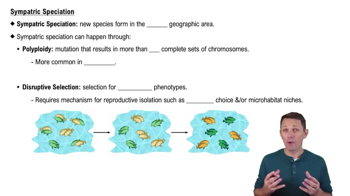
Sympatric speciation occurs when new species arise from a single ancestral species while inhabiting the same geographic area. This process often involves reproductive isolation mechanisms, such as behavioral differences or mating preferences, that prevent interbreeding. In the case of crickets, if females preferentially select males with specific mating calls, this could lead to the emergence of distinct populations that diverge over time despite living in the same environment.
Video consigliato:
Percorso guidato
03:57
Sympatric Speciation

Reproductive Isolation

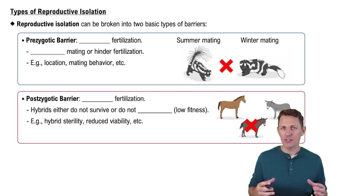
Reproductive isolation is a key mechanism in speciation that prevents different species from interbreeding. It can occur through various means, including temporal isolation (differences in mating times), behavioral isolation (differences in mating rituals), and mechanical isolation (incompatibility of reproductive organs). In the scenario of crickets, if females develop a preference for certain mating calls, this behavioral isolation could lead to the formation of new species as males with less preferred calls are less likely to reproduce.
Video consigliato:
Percorso guidato
02:47
Types of Reproductive Isolation
Pratica correlata
Domanda del libro di testo

When the ranges of two different species meet, a stable 'hybrid zone' occupied by hybrid individuals may form. How is this possible?

a. Two diverged populations are capable of mating and producing viable and fertile offspring.

b. Hybrid individuals are always allopolyploid and are thus unable to mate with either of the original species.

c. Hybrid individuals may have reduced fitness and thus be strongly selected against.

d. One species has a selective advantage, so as hybridization continues, the other species will go extinct.

739
views
Domanda del libro di testo

If one species (2n = 10) crosses with another species (2n = 18), producing an allopolyploid offspring, what is the ploidy of the offspring?

a. 2n = 10

b. 2n = 18

c. 2n = 10+18 = 28

d. 4n = 36 +20 = 56

1133
views
Domanda del libro di testo

True or false? Speciation is a slow process. Justify your answer.

1337
views
Domanda del libro di testo

Evaluate this statement: Gene flow increases the genetic divergence of populations.

1138
views
Domanda del libro di testo

Three-spine sticklebacks are small fish that originated in the ocean and continue to exist there, but then some took up residence in hundreds of streams and freshwater lakes in the Northern Hemisphere. Predict whether you would expect to find different species in lakes today.

787
views
Domanda del libro di testo

Select True or False to indicate which of the following groups could be identified using the biological species concept.

T/F lizard species living today

T/F sunflower species living today

T/F extinct dinosaurs

T/F bacteria living today

811
views