
Ch. 25 - Phylogenies and the History of Life
Freeman - Biological Science 8th Edition
Freeman8th EditionBiological ScienceISBN: 9780138276263Non è quello che usi tu?Cambia libro di testo
Capitolo 25, Problema 14

The vast majority of animals that ever existed are now extinct, but Tereza Jezkova and John Wiens wondered which variables were most important in driving the diversification of species that exist today. Why are there so many species in some phyla, such as Cnidaria (see photo), but so few in others, such as Ctenophora? A sample of Jekova and Wiens' results is shown here. The R2 value represents the strength of the correlation (where 0.00 is lowest and 1.00 is highest). The P value represents the statistical significance. Which five traits look most important?

Guida verificata passo dopo passo
1
Identify the traits with the highest R^2 values, as these indicate the strongest correlations.
Check the P values for these traits to ensure they are statistically significant (P < 0.05).
Photoreceptors/eyes have an R^2 of 0.38 and a P value < 0.001, indicating a strong and significant correlation.
Terrestrial lifestyle has an R^2 of 0.27 and a P value of 0.005, indicating a strong and significant correlation.
Parasitic lifestyle has an R^2 of 0.26 and a P value of 0.005, indicating a strong and significant correlation.
Separate sexes have an R^2 of 0.17 and a P value of 0.027, indicating a significant correlation.
Skeleton has an R^2 of 0.14 and a P value of 0.047, indicating a significant correlation.

Risposta video verificata per un problema simile:

Questa soluzione video è stata consigliata dai nostri tutor come utile per risolvere questo problema.
Durata del video:
4m

Concetti chiave

Ecco i concetti essenziali che devi comprendere per rispondere correttamente alla domanda.

Species Diversification

Species diversification refers to the process by which new species arise and existing species evolve over time. Factors influencing diversification include environmental changes, ecological niches, and evolutionary adaptations. Understanding why certain groups, like Cnidaria, have more species than others, such as Ctenophora, requires analyzing these factors and their interactions.
Video consigliato:
Percorso guidato
03:24
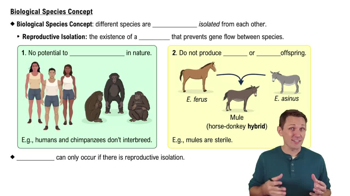
Biological Species Concept

Statistical Significance (P-value)

The P-value is a statistical measure that helps determine the significance of results in hypothesis testing. A low P-value (typically < 0.05) indicates strong evidence against the null hypothesis, suggesting that the observed traits are likely to be important in species diversification. In the context of the study, traits with low P-values are more likely to be significant contributors to the differences in species richness.
Video consigliato:
Percorso guidato
08:26
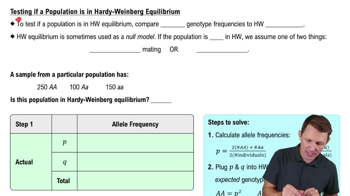
Testing if a Population is in Hardy-Weinberg Equilibrium

Correlation Coefficient (R²)

The R² value, or coefficient of determination, quantifies the strength of the relationship between two variables, ranging from 0 to 1. A higher R² value indicates a stronger correlation, suggesting that the presence of certain traits is closely linked to species diversification. In the study, traits with higher R² values are more likely to be influential in explaining the variation in species numbers across different phyla.
Video consigliato:
04:08
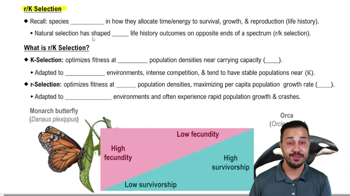
r/K Selection
Pratica correlata
Domanda del libro di testo

The vast majority of animals that ever existed are now extinct, but Tereza Jezkova and John Wiens wondered which variables were most important in driving the diversification of species that exist today. Why are there so many species in some phyla, such as Cnidaria, but so few in others, such as Ctenophora? Based on your reading of this chapter, propose at least five traits that you think might have been most important in triggering diversification within phyla (examples: origin of hearing, origin of internal fertilization).

754
views
Domanda del libro di testo

The vast majority of animals that ever existed are now extinct, but Tereza Jezkova and John Wiens wondered which variables were most important in driving the diversification of species that exist today. Why are there so many species in some phyla, such as Cnidaria (see photo), but so few in others, such as Ctenophora? The researchers know that correlation does not equal causation. However, can the absence of a correlation enable you to reject a hypothesis of causation? How would the R2 values be different in a scenario where a single trait was important to diversification in many phyla versus a scenario where different traits were important to diversification in different phyla?

534
views
Domanda del libro di testo

Use the fossil evidence shown in Figure 25.6 to determine whether flight evolved earlier in insects or in birds. Is flight an example of homology or convergent evolution? Explain.

708
views
Domanda del libro di testo

The vast majority of animals that ever existed are now extinct, but Tereza Jezkova and John Wiens wondered which variables were most important in driving the diversification of species that exist today. Why are there so many species in some phyla, such as Cnidaria (see photo), but so few in others, such as Ctenophora? Jezkova and Wiens used a type of graph called a linear regression to find correlations between variables such as the proportion of species per phylum with legs (on the y-axis) and the diversification rate per phylum (on the x-axis). Sketch a graph to show what a strong positive correlation between these two variables would look like and what the absence of a correlation would look like.

639
views
Domanda del libro di testo

Which traits do not correlate strongly with diversification rate within phyla but are likely to have been important in the original diversification of animal phyla during the Cambrian? Select True or False for each trait.

T/F presence of a head

T/F mobile lifestyle

T/F terrestrial lifestyle

T/F bilateral symmetry

658
views