
Ch. 26 - Bacteria and Archaea
Freeman - Biological Science 8th Edition
Freeman8th EditionBiological ScienceISBN: 9780138276263Non è quello che usi tu?Cambia libro di testo
Capitolo 26, Problema 3

Unlike plant cell walls that contain cellulose, bacterial cell walls are composed of ___________.

Guida verificata passo dopo passo
1
Understand the structure of bacterial cell walls: Bacterial cell walls are primarily composed of a substance called peptidoglycan, which is a polymer consisting of sugars and amino acids.
Compare bacterial cell walls to plant cell walls: Plant cell walls are made of cellulose, a polysaccharide, whereas bacterial cell walls contain peptidoglycan, which provides structural support and shape to the bacteria.
Explore the composition of peptidoglycan: Peptidoglycan is made up of repeating units of two types of sugars, N-acetylglucosamine (NAG) and N-acetylmuramic acid (NAM), linked together by short peptide chains.
Consider the function of peptidoglycan: The peptidoglycan layer is crucial for maintaining the integrity and shape of the bacterial cell, protecting it from osmotic pressure and environmental stress.
Recognize the significance of peptidoglycan in bacterial classification: The presence and thickness of peptidoglycan in bacterial cell walls are used to classify bacteria into Gram-positive and Gram-negative groups, which have different structural characteristics.

Risposta video verificata per un problema simile:

Questa soluzione video è stata consigliata dai nostri tutor come utile per risolvere questo problema.
Durata del video:
28s

Concetti chiave

Ecco i concetti essenziali che devi comprendere per rispondere correttamente alla domanda.

Bacterial Cell Wall Composition

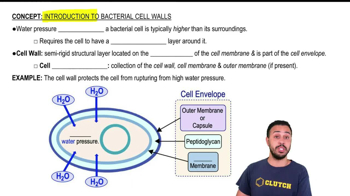
Bacterial cell walls are primarily composed of peptidoglycan, a complex polymer consisting of sugars and amino acids. This structure provides rigidity and protection, distinguishing bacterial cells from plant cells, which have cellulose-based walls. Peptidoglycan's unique composition is crucial for maintaining cell shape and integrity in bacteria.
Video consigliato:
03:44
Introduction to Bacterial Cell Walls

Peptidoglycan Structure

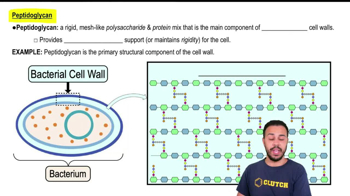
Peptidoglycan is a mesh-like layer that forms the cell wall of most bacteria, composed of repeating units of N-acetylglucosamine and N-acetylmuramic acid linked by short peptide chains. This structure is essential for bacterial survival, providing mechanical strength and preventing osmotic lysis. The cross-linking of peptides gives peptidoglycan its rigidity and resilience.
Video consigliato:
01:58
Peptidoglycan

Differences Between Plant and Bacterial Cell Walls

Plant cell walls are primarily made of cellulose, a polysaccharide that provides structural support and protection. In contrast, bacterial cell walls are composed of peptidoglycan, which is unique to bacteria and serves similar protective functions. Understanding these differences is crucial for studying cell wall synthesis and targeting bacterial infections with antibiotics.
Video consigliato:
03:44
Introduction to Bacterial Cell Walls
Pratica correlata
Domanda del libro di testo

Evaluate these statements about Koch's postulates, which are used to establish a causative link between a specific microbe and a specific disease. Select True or False for each statement.

T/FThe microbe must be present in individuals suffering from the disease and absent from healthy individuals.

T/FThe microbe must be isolated and grown in pure culture.

T/FIf organisms from the pure culture are injected into a healthy experimental animal, the disease symptoms should appear.

T/FThe microbe does not have to be isolated from the experimental animal as long as the disease is present.

1093
views
Domanda del libro di testo

What are organisms called that use inorganic compounds as electron donors in cellular respiration?

a. Phototrophs

b. Heterotrophs

c. Organotrophs

d. Lithotrophs

1321
views
Domanda del libro di testo

What do some photosynthetic bacteria use as a source of electrons instead of water?

a. Oxygen (O2)

b. Hydrogen sulfide (H2S)

c. Organic compounds (e.g., CH3COO−)

d. Nitrate (NO3-)

1372
views
Domanda del libro di testo

Biologists often use the term 'energy source' as a synonym for 'electron donor.' Why?

990
views
Domanda del libro di testo

What has metagenomic analysis allowed researchers to do for the first time? a. sample organisms from an environment and grow them under defined conditions in the lab b. isolate organisms from an environment and sequence their entire genome c. study organisms that cannot be cultured (grown in the lab) d. identify important morphological differences among species

697
views