Ch. 28 - Green Algae and Land Plants
Freeman - Biological Science 8th Edition
Freeman8th EditionBiological ScienceISBN: 9780138276263Non è quello che usi tu?Cambia libro di testo
Capitolo 28, Problema 4

Evaluate the following statements regarding seeds. Select True or False for each statement.
T/FThey contain an embryo.
T/FThey contain nutritive tissue for the embryo.
T/FThey consist entirely of diploid cells.
T/FThey are also referred to as spores.

Guida verificata passo dopo passo
1
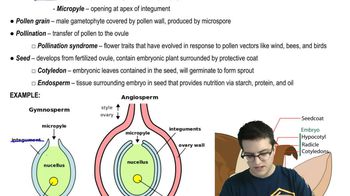
Understand the structure of a seed: A seed typically contains three main components - the embryo, the seed coat, and the nutritive tissue (endosperm or cotyledons). The embryo is the young plant that will develop into a new organism.
Evaluate the statement 'They contain an embryo': Since the embryo is a fundamental part of a seed, this statement is true. The embryo is the part of the seed that will grow into a new plant.
Evaluate the statement 'They contain nutritive tissue for the embryo': Seeds contain nutritive tissue, such as endosperm or cotyledons, which provide essential nutrients to the embryo during germination. Therefore, this statement is true.
Evaluate the statement 'They consist entirely of diploid cells': Seeds contain both diploid and haploid cells. The embryo is diploid, but the nutritive tissue can be triploid (as in the case of endosperm in angiosperms). Therefore, this statement is false.
Evaluate the statement 'They are also referred to as spores': Seeds and spores are different structures. Spores are typically single-celled and used for asexual reproduction, while seeds are multicellular and used for sexual reproduction. Therefore, this statement is false.

Risposta video verificata per un problema simile:

Questa soluzione video è stata consigliata dai nostri tutor come utile per risolvere questo problema.
Durata del video:
54s

Concetti chiave

Ecco i concetti essenziali che devi comprendere per rispondere correttamente alla domanda.

Seed Structure

Seeds are composed of three main parts: the embryo, the endosperm (or nutritive tissue), and the seed coat. The embryo is the young plant that will develop into a new plant, while the endosperm provides the necessary nutrients for the embryo's growth. Understanding these components is crucial for evaluating statements about seeds.
Video consigliato:
06:26
Seed Plants - 1

Ploidy Levels in Seeds

Seeds contain cells with different ploidy levels. The embryo is typically diploid, resulting from the fusion of haploid gametes. However, the endosperm, which provides nutrition, is often triploid in angiosperms due to double fertilization. Recognizing these ploidy variations is essential for assessing statements about seed cell composition.
Video consigliato:
06:26
Seed Plants - 1

Difference Between Seeds and Spores

Seeds and spores are both reproductive structures, but they differ significantly. Seeds are complex structures containing an embryo and nutritive tissue, while spores are usually single-celled and do not contain an embryo. Spores are primarily used by non-seed plants like ferns and fungi for reproduction. Understanding these differences helps in distinguishing between seeds and spores.
Video consigliato:
06:26
Seed Plants - 1