Ch. 28 - Green Algae and Land Plants
Freeman - Biological Science 8th Edition
Freeman8th EditionBiological ScienceISBN: 9780138276263Non è quello che usi tu?Cambia libro di testo
Capitolo 28, Problema 12

<Image>
Moss sperm are motile and capable of swimming short distances to fertilize an egg. However, it was unknown until recently how sperm make their way from male to female gametophytes that may be separated by a distance of several centimeters or more.
What structure do moss sperm use for motility, and how does that reflect the evolution of land plants from green algae?

Guida verificata passo dopo passo
1
Moss sperm use flagella for motility. Flagella are whip-like structures that enable the sperm to swim through water to reach the egg.
The presence of flagella in moss sperm reflects an evolutionary adaptation from their aquatic ancestors, the green algae, which also use flagella for movement in water.
In the context of land plants, the motility of sperm using flagella indicates a reliance on water for fertilization, a trait inherited from aquatic ancestors.
This adaptation highlights the transitional phase in plant evolution where early land plants still depended on moist environments for reproduction, similar to their algal predecessors.
Understanding the role of flagella in moss sperm motility provides insight into the evolutionary pressures faced by early land plants as they adapted to terrestrial life while retaining some aquatic reproductive strategies.

Risposta video verificata per un problema simile:

Questa soluzione video è stata consigliata dai nostri tutor come utile per risolvere questo problema.
Durata del video:
33s

Concetti chiave

Ecco i concetti essenziali che devi comprendere per rispondere correttamente alla domanda.

Moss Sperm Motility

Moss sperm are motile, meaning they can move independently, typically using flagella. These whip-like structures enable sperm to swim through water films or moist environments to reach the egg. This motility is crucial for fertilization in non-vascular plants like mosses, which rely on water for reproduction.
Video consigliato:
03:21
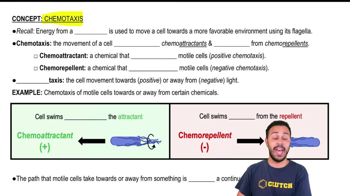
Chemotaxis

Flagella in Moss Sperm

Flagella are long, slender appendages that protrude from the cell body, enabling movement. In moss sperm, flagella facilitate swimming by creating wave-like motions. This structure is similar to that found in many aquatic organisms, reflecting an evolutionary adaptation from ancestral green algae, which also used flagella for motility.
Video consigliato:
03:15
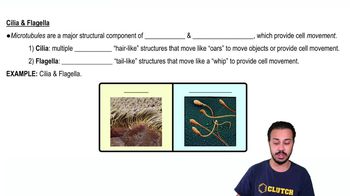
Cilia & Flagella

Evolution of Land Plants from Green Algae

The transition from aquatic green algae to terrestrial plants involved adaptations for survival on land, including reproductive strategies. Mosses, as early land plants, retained the use of flagellated sperm, a trait from their aquatic ancestors, highlighting the evolutionary link and the gradual adaptation to terrestrial life while still relying on water for reproduction.
Video consigliato:
12:33
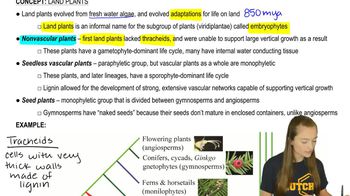
Land Plants
Pratica correlata
Domanda del libro di testo

<Image>

Moss sperm are motile and capable of swimming short distances to fertilize an egg. However, it was unknown until recently how sperm make their way from male to female gametophytes that may be separated by a distance of several centimeters or more.

Besides springtails, are there other ways moss sperm may be transferred from male to female gametophytes?

692
views
Domanda del libro di testo

Angiosperms such as grasses, oaks, and maples are wind pollinated. The ancestors of these subgroups were probably pollinated by insects, however. As an adaptive advantage, why might a species 'revert' to wind pollination? (Hint: Think about the costs and benefits of being pollinated by insects versus wind.) Why is it logical to observe that wind-pollinated species usually grow in dense stands containing many individuals of the same species? Why is it logical to observe that in wind-pollinated deciduous trees, flowers form very early in spring—before leaves form?

866
views
Domanda del libro di testo

Moss sperm are motile and capable of swimming short distances to fertilize an egg. However, it was unknown until recently how sperm make their way from male to female gametophytes that may be separated by a distance of several centimeters or more. A friend in your biology study group claims that eggs in mosses are fertilized by spores. What is wrong with that statement?

1017
views
Domanda del libro di testo

<Image>

Moss sperm are motile and capable of swimming short distances to fertilize an egg. However, it was unknown until recently how sperm make their way from male to female gametophytes that may be separated by a distance of several centimeters or more.

Beyond the results presented here, what other evidence would be useful when drawing conclusions about the role of springtails in moss reproduction?

535
views
Domanda del libro di testo

You have been hired as a field assistant for a researcher interested in the evolution of flower characteristics in orchids. Design an experiment to determine whether color, size, shape, scent, or amount of nectar is the most important factor in attracting pollinators to a particular species. Assume that you can change any flower's color with a dye and that you can remove petals or nectar stores, add particular scents, add nectar by injection, or switch parts among species by cutting and gluing.

694
views
Domanda del libro di testo

<Image>

Moss sperm are motile and capable of swimming short distances to fertilize an egg. However, it was unknown until recently how sperm make their way from male to female gametophytes that may be separated by a distance of several centimeters or more.

Researchers hypothesized that small animals called springtails (a type of arthropod) facilitate sperm transfer in mosses. To test this hypothesis, the researchers grew patches of male and female mosses at varying distances from each other and in the presence or absence of springtails. They later checked to see how many sporophytes were found in each female patch (as an indicator that fertilization had occurred). Their results are shown in the graph here (** means P<0.01, * means P>0.05. What conclusions can be drawn about the role of the springtails during the reproductive cycle of the mosses?

526
views