Ch. 30 - An Introduction to Animals
Freeman - Biological Science 8th Edition
Freeman8th EditionBiological ScienceISBN: 9780138276263Non è quello che usi tu?Cambia libro di testo
Capitolo 30, Problema 1

True or false? Multicellularity is homologous in animals and land plants.

Guida verificata passo dopo passo
1
Understand the term 'homologous' in a biological context, which refers to traits or structures that are derived from the same evolutionary origin or ancestral source.
Recognize that multicellularity refers to organisms composed of more than one cell, which can differentiate and perform specialized functions.
Research the evolutionary origins of multicellularity in animals and land plants to determine if they share a common ancestor specifically for this trait.
Analyze whether the development of multicellularity in animals and land plants occurred independently or from a shared multicellular ancestor.
Conclude whether the statement is true or false based on whether multicellularity in animals and land plants originated from the same ancestral source (homologous) or through separate evolutionary events (analogous).

Concetti chiave

Ecco i concetti essenziali che devi comprendere per rispondere correttamente alla domanda.

Homology

Homology refers to the similarity in structure or function between different species that arises from a common ancestor. In biology, homologous traits indicate evolutionary relationships and can be used to trace lineage. Understanding homology is crucial for determining whether multicellularity in animals and land plants shares a common evolutionary origin.
Video consigliato:
08:09
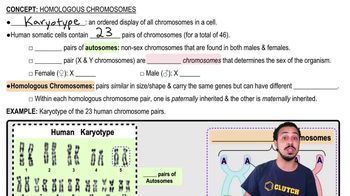
Homologous Chromosomes

Multicellularity

Multicellularity is the condition of being composed of multiple cells that work together to form a complex organism. This trait allows for specialization of cells, leading to more efficient functioning and adaptation. The evolution of multicellularity is a significant event in the history of life, occurring independently in various lineages, including animals and plants.
Video consigliato:
02:09
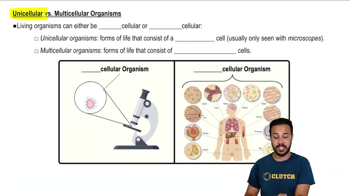
Unicellular vs. Multicellular

Convergent Evolution

Convergent evolution occurs when different species independently evolve similar traits or features as a result of adapting to similar environments or ecological niches. This concept is important in understanding that multicellularity in animals and land plants may not be homologous, as it could have arisen through convergent evolution rather than from a shared ancestor.
Video consigliato:
05:22
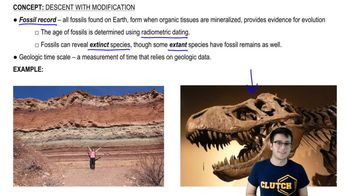
Convergent and Divergent Evolution