Ch. 31 - Protostome Animals
Freeman - Biological Science 8th Edition
Freeman8th EditionBiological ScienceISBN: 9780138276263Non è quello che usi tu?Cambia libro di testo
Capitolo 31, Problema 5

Propose an explanation for why annelids and arthropods were thought to be closely related, before phylogenetic analyses in the late 1990s.

Guida verificata passo dopo passo
1
Identify the similarities between annelids and arthropods that led to the initial assumption of close relation, such as segmented bodies, presence of a coelom, and a similar nervous system structure.
Discuss the concept of convergent evolution, where unrelated species independently evolve similar traits as a result of having to adapt to similar environments or ecological niches.
Explain the role of traditional taxonomy based on morphological characteristics, which might have emphasized visible similarities and overlooked genetic differences.
Introduce the impact of molecular and genetic data obtained in the late 1990s, which provided new insights into evolutionary relationships through DNA analysis, leading to a reevaluation of the phylogenetic tree.
Clarify the current understanding based on molecular phylogenetics, which shows that annelids and arthropods are not as closely related as previously thought, belonging to different clades within the Protostomia.

Risposta video verificata per un problema simile:

Questa soluzione video è stata consigliata dai nostri tutor come utile per risolvere questo problema.
Durata del video:
1m

Concetti chiave

Ecco i concetti essenziali che devi comprendere per rispondere correttamente alla domanda.

Annelid and Arthropod Morphology

Annelids, such as earthworms, and arthropods, like insects and crustaceans, share several morphological features, including segmented bodies and similar organ systems. This segmentation led early biologists to group them together, as both exhibit a division of labor among body segments, which was thought to indicate a close evolutionary relationship.
Video consigliato:
06:13
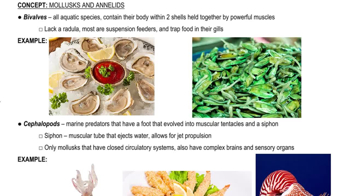
Mollusks and Annelids

Common Ancestry and Evolutionary Relationships

Before the advent of molecular phylogenetics, scientists relied heavily on morphological characteristics to infer evolutionary relationships. The similarities in body structure and developmental patterns between annelids and arthropods suggested a common ancestor, leading to the hypothesis that they diverged from a shared lineage.
Video consigliato:
Percorso guidato
02:45
History of Evolutionary Theory Example 1

Phylogenetic Analysis

Phylogenetic analysis involves the use of genetic data to construct evolutionary trees that depict relationships among species. In the late 1990s, advancements in molecular techniques allowed for more accurate assessments of these relationships, revealing that annelids and arthropods are not as closely related as previously thought, challenging earlier morphological classifications.
Video consigliato:
Percorso guidato
04:13
Building Phylogenetic Trees Example 2