Ch. 35 - Water and Sugar Transport in Plants
Freeman - Biological Science 8th Edition
Freeman8th EditionBiological ScienceISBN: 9780138276263Non è quello che usi tu?Cambia libro di testo
Capitolo 35, Problema 10

Salt is used to melt snow and keep roads clear during the winter in many cities. Land adjacent to de-iced roads often ends up with a high concentration of salt in the soil. Explain why plants growing near salted roads may appear wilted in the spring.

Guida verificata passo dopo passo
1
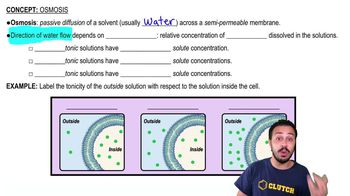
Understand osmosis: Osmosis is the movement of water across a semipermeable membrane from an area of low solute concentration to an area of high solute concentration. In this context, the solute is salt.
Recognize the effect of salt on soil: When roads are salted, the salt can accumulate in the soil of adjacent areas, increasing the soil's solute concentration.
Analyze plant water absorption: Plants absorb water from the soil through their roots. Normally, the inside of the plant's cells has a higher solute concentration than the surrounding soil, allowing water to move into the plant.
Consider the impact of high salt concentration: With increased salt in the soil, the external solute concentration may become higher than the internal solute concentration of the plant cells. This can reverse the normal direction of osmosis, causing water to move out of the plant cells.
Explain plant wilting: As water moves out of the plant cells, they lose turgor pressure, which is necessary to keep the plant upright and firm. This loss of turgor pressure leads to wilting, explaining why plants near salted roads may appear wilted in the spring.

Risposta video verificata per un problema simile:

Questa soluzione video è stata consigliata dai nostri tutor come utile per risolvere questo problema.
Durata del video:
1m

Concetti chiave

Ecco i concetti essenziali che devi comprendere per rispondere correttamente alla domanda.

Osmosis

Osmosis is the movement of water across a semipermeable membrane from an area of lower solute concentration to an area of higher solute concentration. In the context of plants, when soil near salted roads has a high concentration of salt, it creates a hypertonic environment. This causes water to move out of the plant roots into the soil, leading to dehydration and wilting.
Video consigliato:
05:59
Osmosis

Salt Stress

Salt stress occurs when plants are exposed to high levels of salt in the soil, which can disrupt their physiological processes. This stress can lead to reduced water uptake, ion toxicity, and nutrient imbalances, ultimately affecting plant growth and health. Plants may exhibit symptoms such as wilting, leaf burn, and stunted growth as a result of this stress.
Video consigliato:
06:17
Adrenal Glands

Plant Adaptations

Plants have developed various adaptations to cope with saline environments, such as salt excretion mechanisms and specialized root structures. However, many plants are not well-equipped to handle excessive salt levels, which can overwhelm their natural defenses. Understanding these adaptations helps explain why some plants may struggle to survive near salted roads, leading to visible wilting in the spring.
Video consigliato:
Percorso guidato
05:24
Adaptive Radiation
Pratica correlata
Domanda del libro di testo

A mutant plant lacking the ability to pump protons out of leaf companion cells will be unable to do which of the following?

a. Initiate transpiration

b. Load sucrose into sieve-tube elements

c. Carry out photosynthesis

d. Transport water through the xylem

708
views
Domanda del libro di testo

Atmospheric CO₂ has been increasing rapidly since the late 1800s, largely due to human activities. Recall that CO₂ enters leaves through stomata and can then be used for photosynthesis. However, transpiration occurs as a result of water evaporating through stomata. How have plants responded to elevated CO₂ levels? The amount of water that evaporates from stomata over a period of time is referred to as stomatal conductance, which is determined largely by the number of stomata in a given area of leaf surface. Researchers obtained specimens from preserved collections and measured stomatal conductance in leaves from oak trees and pine trees that grew at various times under different CO₂ levels. The data are shown in the following graph. In general, is the maximum stomatal conductance rate in plants more or less than it was a century ago?

1076
views
Domanda del libro di testo

Atmospheric CO₂ has been increasing rapidly since the late 1800s, largely due to human activities. Recall that CO₂ enters leaves through stomata and can then be used for photosynthesis. However, transpiration occurs as a result of water evaporating through stomata.

How have plants responded to elevated CO₂ levels?

What impact, if any, do you predict elevated CO₂ levels will have on the number of stomata in leaves and on the transpiration rate?

617
views
Domanda del libro di testo

Your friend claims that phloem always carries sugars down a plant. What, if anything, is wrong with that statement?

838
views
Domanda del libro di testo

Atmospheric CO₂ has been increasing rapidly since the late 1800s, largely due to human activities. Recall that CO₂ enters leaves through stomata and can then be used for photosynthesis. However, transpiration occurs as a result of water evaporating through stomata. How have plants responded to elevated CO₂ levels?

Which of these structural features can help to limit water loss in plants that occupy dry habitats?

a. Abundant companion cells and sieve-tube elements

b. Stomata that are located in pits on the undersides of their leaves, or narrow, needlelike leaves c. extensive networks of xylem and phloem

d. Stomata that are located on the top surface of leaves, or broad leaves

757
views
Domanda del libro di testo

Consider a tree that is 50 m tall and is transpiring roughly 90 liters of water each day. Approximately how many calories will the tree use to transpire this quantity of water?

930
views