

Ch. 35 - Water and Sugar Transport in Plants
Freeman - Biological Science 8th Edition
Freeman8th EditionBiological ScienceISBN: 9780138276263Non è quello che usi tu?Cambia libro di testo
Capitolo 35, Problema 5

The cells of a certain plant species can accumulate solutes to create very low solute potentials. Which of these statements is correct?
a. The plant's transpiration rates will tend to be extremely low.
b. The plant can compete for water effectively and live in relatively dry soils.
c. The plant will grow most effectively in soils that are saturated with water year-round.
d. The plant's leaves will wilt easily.

Guida verificata passo dopo passo
1
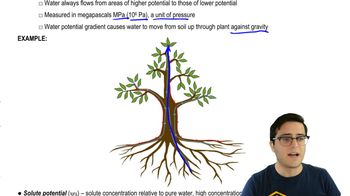
Understand the concept of solute potential: Solute potential, also known as osmotic potential, is a measure of the tendency of water to move into a solution due to solute concentration. A lower solute potential means the solution is more concentrated with solutes, which can draw water into the cells.
Consider the effect of low solute potential on water movement: When plant cells have a very low solute potential, they can draw water from the surrounding environment more effectively. This is because water moves from areas of higher water potential (less solute concentration) to areas of lower water potential (more solute concentration).
Evaluate the plant's ability to compete for water: With low solute potential, the plant can effectively draw water from relatively dry soils, as it can create a stronger gradient for water movement into its cells compared to other plants with higher solute potentials.
Analyze the implications for transpiration rates: Transpiration is the process of water movement through a plant and its evaporation from aerial parts, like leaves. Low solute potential does not directly imply low transpiration rates; rather, it suggests the plant can maintain water uptake even in dry conditions.
Consider the plant's growth environment: While low solute potential allows the plant to survive in dry soils, it does not necessarily mean the plant will grow most effectively in saturated soils. In fact, plants adapted to dry conditions may not thrive in overly wet environments.

Risposta video verificata per un problema simile:

Questa soluzione video è stata consigliata dai nostri tutor come utile per risolvere questo problema.
Durata del video:
1m

Concetti chiave

Ecco i concetti essenziali che devi comprendere per rispondere correttamente alla domanda.

Solute Potential

Solute potential, also known as osmotic potential, is a measure of the tendency of water to move into a solution due to solute concentration. In plants, low solute potential means that cells can draw in water more effectively, which is crucial for maintaining turgor pressure and overall plant hydration, especially in dry environments.
Video consigliato:
11:32
Water Potential

Transpiration

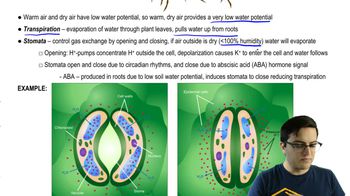
Transpiration is the process by which water vapor is lost from plant leaves through stomata. It plays a key role in water uptake and nutrient transport. Plants with low solute potential can reduce transpiration rates, conserving water in dry conditions, but this may also limit cooling and nutrient flow, affecting growth.
Video consigliato:
08:29
Water Potential in Soil and Air

Water Competition in Plants

Plants compete for water in their environment, especially in dry soils. Those with the ability to lower their solute potential can draw water more effectively from the soil, giving them a competitive advantage in arid conditions. This adaptation allows them to survive and thrive where water is scarce.
Video consigliato:
02:13
Community Interactions: Competition (-/-)
Pratica correlata
Domanda del libro di testo

A mutant plant lacking the ability to pump protons out of leaf companion cells will be unable to do which of the following?

a. Initiate transpiration

b. Load sucrose into sieve-tube elements

c. Carry out photosynthesis

d. Transport water through the xylem

708
views
Domanda del libro di testo

What important role does the Casparian strip play in the movement of water through plants?

a. Forces water to move through the cytoplasm of living endodermal cells as it makes its way from the soil to the xylem

b. Causes cells to shrink, thereby increasing pressure within cells

c. Loads sugars into xylem, thereby causing water to enter the xylem by osmosis

d. Acts as a filter that prevents salts, heavy metals, and other pollutants from entering root hairs

2191
views
Domanda del libro di testo

Consider the following statements regarding the transport of phloem sap. Select True or False for each statement.

T/F This is a passive process that is driven by the evaporation of water from leaves.

T/F Sugars tend to move from sources to sinks.

T/F Phloem sap moves through sieve-tube elements under positive pressure.

T/F Sieve-tube elements and vessel elements are commonly involved in the transport of phloem sap.

784
views
Domanda del libro di testo

What is the role of companion cells in the movement of sugars through plants?

a. They are the sites of sugar production by photosynthesis.

d. They are the sites where starch is converted to sucrose.

c. They secrete sucrose, which draws sugars through phloem under negative pressure.

d. They accumulate sucrose, which is then transferred to adjacent sieve-tube elements.

915
views
Domanda del libro di testo

Your friend claims that phloem always carries sugars down a plant. What, if anything, is wrong with that statement?

838
views
Domanda del libro di testo

Draw a plant cell in pure water. Add dots to indicate solutes inside the cell. Now add more dots to indicate an increase in solute potential inside the cell. Add an arrow showing the net direction of water movement in response. Add arrows showing the direction of wall pressure and turgor pressure in response to water movement. Repeat the same exercise, but this time, add solutes to the solution outside the cell at a concentration that is greater than inside the cell.

949
views