Ch. 36 - Plant Nutrition
Freeman - Biological Science 8th Edition
Freeman8th EditionBiological ScienceISBN: 9780138276263Non è quello che usi tu?Cambia libro di testo
Capitolo 36, Problema 7

Your friend claims that all plants are autotrophs because they perform photosynthesis. Is that a correct statement? Explain.

Guida verificata passo dopo passo
1
Step 1: Understand the terms. Autotrophs are organisms that can produce their own food from the substances available in their surroundings using light (photosynthesis) or chemical energy (chemosynthesis). Photosynthesis is a process used by plants and other organisms to convert light energy, usually from the Sun, into chemical energy that can be later released to fuel the organisms' activities.
Step 2: Consider the claim. The claim is that all plants are autotrophs because they perform photosynthesis. This implies that all plants are capable of producing their own food using light energy.
Step 3: Evaluate the claim. While it's true that most plants are autotrophs and perform photosynthesis, not all plants are autotrophs. Some plants, known as heterotrophs, cannot produce their own food and must obtain it from other sources. Examples of heterotrophic plants include parasitic plants like the dodder (Cuscuta) and myco-heterotrophic plants that rely on symbiotic relationships with fungi.
Step 4: Formulate your response. Based on the information above, the claim that all plants are autotrophs because they perform photosynthesis is not entirely correct. While most plants are autotrophs and perform photosynthesis, there are exceptions.
Step 5: Conclude your explanation. Therefore, while the majority of plants are autotrophs and perform photosynthesis, it is not accurate to say that all plants are autotrophs.

Risposta video verificata per un problema simile:

Questa soluzione video è stata consigliata dai nostri tutor come utile per risolvere questo problema.
Durata del video:
33s

Concetti chiave

Ecco i concetti essenziali che devi comprendere per rispondere correttamente alla domanda.

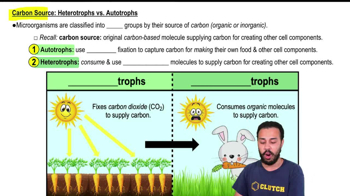
Autotrophs

Autotrophs are organisms that can produce their own food using inorganic substances. They primarily utilize sunlight or chemical energy to convert carbon dioxide and water into glucose through processes like photosynthesis or chemosynthesis. While most plants are autotrophs, this classification does not apply to all organisms traditionally considered plants.
Video consigliato:
02:59
Carbon Source: Heterotrophs vs. Autotrophs

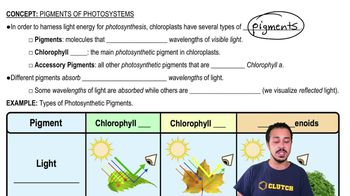
Photosynthesis

Photosynthesis is the biochemical process by which green plants, algae, and some bacteria convert light energy into chemical energy. This process involves the absorption of sunlight by chlorophyll, leading to the transformation of carbon dioxide and water into glucose and oxygen. While it is a defining feature of many plants, not all plants perform photosynthesis, as some may rely on other nutritional sources.
Video consigliato:
05:58
Pigments of Photosynthesis

Heterotrophs

Heterotrophs are organisms that cannot synthesize their own food and instead obtain nutrients by consuming other organisms. This group includes animals, fungi, and some plants, such as parasitic or carnivorous species. Understanding the distinction between autotrophs and heterotrophs is crucial to accurately assess the claim about all plants being autotrophs.
Video consigliato:
02:59
Carbon Source: Heterotrophs vs. Autotrophs
Pratica correlata
Domanda del libro di testo

There is a conflict between van Helmont's data on willow tree growth and the data on essential nutrients listed in Table 36.1. According to the table, nutrients other than C, H, and O should make up about 4 percent of a willow tree's mass. Most or all of these nutrients should come from soil. But van Helmont claimed that the soil in his experiment lost just 60 g, while the tree gained 74,000 g. Calculate the percentage of the added mass accounted for by soil, and compare it to the predicted 4 percent. State at least one hypothesis to explain the conflict between expected and observed results. How would you test this hypothesis?

871
views
Domanda del libro di testo

Why is the presence of clay particles important in soil?

a. They provide macronutrients—particularly nitrogen, phosphorus, and potassium.

b. They bind metal ions, which would be toxic if absorbed by plants.

c. They allow water to percolate through the soil, making oxygen-rich air pockets available. d. The negative charges on clay bind to positively charged ions and prevent them from being leached out of the soil.

1171
views
Domanda del libro di testo

In a semester-long experiment tracking growth in plants, your lab partner—who often skips class—carefully records the mass of water added to a potted plant with the expectation that this addition will be fully accounted for in the mass gained by the plant. Is your lab partner right or wrong? Explain.

796
views
Domanda del libro di testo

Suppose that certain root cells have an overall charge that is more negative than normal. What impact would this likely have on the uptake of anions such as NO3⁻?

a. Anions would be less likely to enter roots.

b. Anions would be more likely to enter roots.

c. This would have no impact on the ability of anions to enter roots.

d. This would make anions and cations equally likely to enter roots.

1046
views
Domanda del libro di testo

Why is it important for plants to exclude certain ions?

Summarize the difference between active and passive exclusion mechanisms.

835
views
Domanda del libro di testo

Design an experiment, using radioactive carbon and the heavy isotope of nitrogen (15N2), that would test whether the Rhizobia–pea plant interaction is mutualistic.

852
views