
Ch. 39 - Animal Form and Function
Freeman - Biological Science 8th Edition
Freeman8th EditionBiological ScienceISBN: 9780138276263Non è quello che usi tu?Cambia libro di testo
Capitolo 39, Problema 14

Many species of animals on islands are larger than related species on the mainland. Scientists hypothesize that this phenomenon, called island gigantism, evolved in response to the scarcity of competitors and predators on islands. Reduced competition and predation allow species to exploit more resources and free them from the need to hide in small refuges.
True or false: The body temperatures of island tortoises always closely match the temperatures in their environments.

Guida verificata passo dopo passo
1
Understand the concept of island gigantism: Island gigantism is a biological phenomenon where species on islands grow larger than their mainland relatives, often due to reduced competition and predation.
Consider the biology of tortoises: Tortoises are ectothermic animals, meaning their body temperature is largely influenced by the external environment.
Explore the relationship between ectothermy and environmental temperature: Ectothermic animals, like tortoises, rely on external heat sources to regulate their body temperature, often resulting in their body temperature closely matching the ambient temperature.
Evaluate the statement: Given that tortoises are ectothermic, their body temperature is likely to closely match the environmental temperature, unless they engage in behaviors to regulate it differently.
Conclude based on the evidence: The statement is likely true, as ectothermic animals typically have body temperatures that align with their surroundings, unless specific behaviors or environmental conditions alter this relationship.

Risposta video verificata per un problema simile:

Questa soluzione video è stata consigliata dai nostri tutor come utile per risolvere questo problema.
Durata del video:
43s

Concetti chiave

Ecco i concetti essenziali che devi comprendere per rispondere correttamente alla domanda.

Island Gigantism

Island gigantism refers to the phenomenon where species on islands evolve to be larger than their mainland counterparts. This is often due to reduced competition and predation, allowing species to exploit available resources more effectively. The lack of predators and competitors can lead to evolutionary changes that favor larger body sizes, which can be advantageous in resource-rich environments.
Video consigliato:
03:48
What is the Island Equilibrium Model?

Thermoregulation in Tortoises

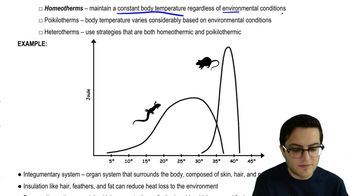
Thermoregulation is the process by which animals maintain their body temperature within certain boundaries, even when environmental temperatures vary. Tortoises, being ectothermic, rely on external heat sources to regulate their body temperature. They may bask in the sun to warm up or seek shade to cool down, meaning their body temperature can closely match the ambient temperature, but not always precisely.
Video consigliato:
09:51
Thermoregulation

Ectothermy

Ectothermy is a biological feature where an organism relies on external environmental heat sources to regulate its body temperature. Unlike endotherms, ectotherms do not generate significant internal heat and must use behavioral adaptations to manage their thermal needs. This can lead to body temperatures that fluctuate with environmental conditions, as seen in reptiles like tortoises.
Video consigliato:
09:51
Thermoregulation
Pratica correlata
Domanda del libro di testo

Many species of animals on islands are larger than related species on the mainland. Scientists hypothesize that this phenomenon, called island gigantism, evolved in response to the scarcity of competitors and predators on islands. Reduced competition and predation allow species to exploit more resources and free them from the need to hide in small refuges. Which of the following might be a trade-off of gigantism experienced by giant island tortoises?

a. They cool very rapidly during cold weather.

b. It would be difficult to sustain their high mass-specific metabolic rates on a diet of plants alone.

c. It could be more difficult to avoid thermally unfavorable conditions.

d. They could hide from nonnative predators more easily.

535
views
Domanda del libro di testo

Many species of animals on islands are larger than related species on the mainland. Scientists hypothesize that this phenomenon, called island gigantism, evolved in response to the scarcity of competitors and predators on islands. Reduced competition and predation allow species to exploit more resources and free them from the need to hide in small refuges.

Which tortoises, mainland or island, need to eat more food per gram of their body mass?

574
views
Domanda del libro di testo

Many species of animals on islands are larger than related species on the mainland. Scientists hypothesize that this phenomenon, called island gigantism, evolved in response to the scarcity of competitors and predators on islands. Reduced competition and predation allow species to exploit more resources and free them from the need to hide in small refuges. On a trip to the Galápagos Islands, you overhear a group of tourists refer to tortoises as 'cold blooded.'

Explain why this word is not accurate to describe a giant tortoise.

959
views
Domanda del libro di testo

Many species of animals on islands are larger than related species on the mainland. Scientists hypothesize that this phenomenon, called island gigantism, evolved in response to the scarcity of competitors and predators on islands. Reduced competition and predation allow species to exploit more resources and free them from the need to hide in small refuges. The graph shown here compares the average carapace (shell) length of mainland and island tortoises. Summarize the results, then use the data to predict whether the surface area to volume ratio is higher in mainland or island tortoises.

638
views
Domanda del libro di testo

Many species of animals on islands are larger than related species on the mainland. Scientists hypothesize that this phenomenon, called island gigantism, evolved in response to the scarcity of competitors and predators on islands. Reduced competition and predation allow species to exploit more resources and free them from the need to hide in small refuges. Suppose that a small mainland tortoise and a large island tortoise are placed in the same pen at a zoo.

Which tortoise will be more poikilothermic, the small or large tortoise? Why?

534
views