Single strands of nucleic acids are directional, meaning that there are two different ends. What functional groups define the two different ends of a strand?
Ch.4 - Nucleic Acids and the RNA World
Freeman8th EditionBiological ScienceISBN: 9780138276263Non è quello che usi tu?Cambia libro di testo
Capitolo 4, Problema 2
What determines the primary structure of a DNA molecule?
a. Stem-and-loop configuration
b. Complementary base pairing
c. Deoxyribonucleotide sequence
d. Hydrophobic interactions and hydrogen bonding
Guida verificata passo dopo passo1
Understand that the primary structure of a DNA molecule refers to the linear sequence of nucleotides.
Recognize that nucleotides in DNA are composed of a sugar (deoxyribose), a phosphate group, and a nitrogenous base.
Identify that the sequence of deoxyribonucleotides, which includes adenine (A), thymine (T), cytosine (C), and guanine (G), determines the primary structure of DNA.
Note that complementary base pairing (b) and hydrogen bonding (d) are involved in the secondary structure, not the primary structure.
Conclude that the correct answer is the deoxyribonucleotide sequence (c), as it directly specifies the order of bases in the DNA strand.

Risposta video verificata per un problema simile:
Questa soluzione video è stata consigliata dai nostri tutor come utile per risolvere questo problema.
Durata del video:
2mConcetti chiave
Ecco i concetti essenziali che devi comprendere per rispondere correttamente alla domanda.
Deoxyribonucleotide Sequence
The primary structure of a DNA molecule is determined by its deoxyribonucleotide sequence. This sequence is the specific order of nucleotides, which are the building blocks of DNA, consisting of a sugar, a phosphate group, and a nitrogenous base. The sequence of these bases (adenine, thymine, cytosine, and guanine) encodes genetic information.
Video consigliato:
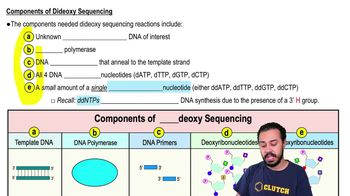
Components of Dideoxy Sequencing
Complementary Base Pairing
Complementary base pairing is a fundamental principle of DNA structure where adenine pairs with thymine and cytosine pairs with guanine. This pairing is crucial for the double helix structure of DNA and ensures accurate replication and transcription processes. However, it is not the primary determinant of the DNA's primary structure, which is the linear sequence of nucleotides.
Video consigliato:
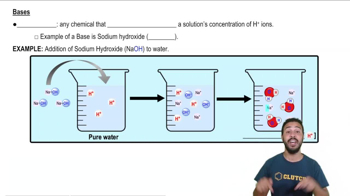
Bases
Hydrogen Bonding
Hydrogen bonding occurs between complementary bases in the DNA double helix, stabilizing its structure. While these interactions are essential for maintaining the double-stranded form of DNA, they do not determine the primary structure. The primary structure is solely defined by the linear sequence of nucleotides, not by the interactions between them.
Video consigliato:
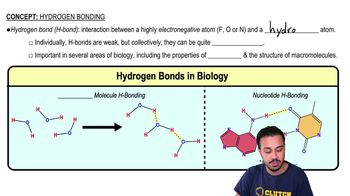
Hydrogen Bonding
Pratica correlata
Domanda del libro di testo
3164
views
Domanda del libro di testo
Evaluate the following statements related to the synthesis of nucleic acids. Select True or False for each statement.
T/F Ribonucleotides are added to the 3′ end of a DNA strand.
T/F Polymerization of nucleic acids occurs by the formation of phosphodiester bonds.
T/F Complementary pairing between sugars is required for copying nucleic acids.
T/F Strands in a double helix are synthesized in an antiparallel orientation.
1812
views
Domanda del libro di testo
What is responsible for the increased stability of DNA compared to RNA?
2954
views
Domanda del libro di testo
What are the four nitrogenous bases found in RNA?
a. Cytosine, guanine, thymine, uracil (C, G, T, U)
b. Adenine, cytosine, guanine, thymine (A, C, G, T)
c. Adenine, cytosine, guanine, uracil (A, C, G, U)
d. Alanine, cysteine, glycine, threonine (A, C, G, T)
2881
views