Ch. 43 - Animal Nervous Systems
Freeman - Biological Science 8th Edition
Freeman8th EditionBiological ScienceISBN: 9780138276263Non è quello che usi tu?Cambia libro di testo
Capitolo 43, Problema 8

Why is memory thought to involve changes in particular synapses?
a. At some synapses, more neurotransmitters are released after learning takes place.
b. At some synapses, a different type of neurotransmitter is released after learning takes place.
c. When researchers stimulated certain neurons electrically, individuals replayed memories.
d. When researchers changed synapses in the brains of patients during surgery, the patients' memories changed.

Guida verificata passo dopo passo
1
Understand the role of synapses in neural communication: Synapses are the junctions between neurons where neurotransmitters are released to transmit signals. Changes in synapses can affect how signals are transmitted and processed in the brain.
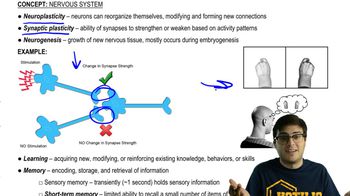
Explore the concept of synaptic plasticity: Synaptic plasticity refers to the ability of synapses to strengthen or weaken over time, in response to increases or decreases in their activity. This is a fundamental mechanism underlying learning and memory.
Consider the impact of neurotransmitter release: After learning takes place, some synapses may release more neurotransmitters, enhancing the communication between neurons and potentially strengthening the memory trace.
Examine the evidence from research studies: Researchers have found that stimulating certain neurons electrically can lead to the replay of memories, suggesting that specific synapses are involved in memory recall.
Analyze the effects of synaptic changes during surgery: Studies have shown that altering synapses in the brain during surgery can lead to changes in patients' memories, indicating that synapses play a crucial role in storing and modifying memories.

Risposta video verificata per un problema simile:

Questa soluzione video è stata consigliata dai nostri tutor come utile per risolvere questo problema.
Durata del video:
2m

Concetti chiave

Ecco i concetti essenziali che devi comprendere per rispondere correttamente alla domanda.

Synaptic Plasticity

Synaptic plasticity refers to the ability of synapses to strengthen or weaken over time, in response to increases or decreases in their activity. This is a fundamental mechanism underlying learning and memory, as changes in synaptic strength can alter the flow of information through neural circuits, thereby encoding new memories.
Video consigliato:
06:58
Phenotypic Plasticity

Neurotransmitter Release

Neurotransmitter release is the process by which signaling molecules are released from neurons to transmit signals across synapses. Changes in the amount or type of neurotransmitter released can affect synaptic strength and are thought to be involved in the formation and storage of memories, as they modify the communication between neurons.
Video consigliato:
12:47
Neurotransmitters

Neural Stimulation and Memory Recall

Neural stimulation involves activating neurons through electrical impulses, which can lead to the recall of memories. This suggests that specific patterns of neural activity are associated with particular memories, and stimulating these patterns can trigger memory retrieval, highlighting the role of synaptic changes in memory storage and recall.
Video consigliato:
07:41
Neuroplasticity, Learning, and Memory
Pratica correlata
Domanda del libro di testo

Describe the role of summation in postsynaptic cells.

1010
views

Domanda del libro di testo

Certain species of frogs in the genus Phyllobates have a powerful defensive adaptation—their skin can secrete a milky fluid that contains an extremely toxic compound called batrachotoxin (BTX). These frogs, which are found in Colombia, are known as poison dart frogs because some indigenous Colombian hunters coat the tips of their blowgun darts with the frogs' skin secretions. An animal hit by one of these darts dies quickly.

What is the mechanism of action of BTX? The graph here shows the effect of BTX on the membrane potential of a squid giant axon.

Which of the following is the most likely explanation for the effect of BTX on the squid giant axon?

a. Inactivation of Na+/K+-ATPase

b. Closing of sodium channels

c. Opening of sodium channels

d. Opening of potassium channels

856
views
Domanda del libro di testo

Explain the difference between a ligand-gated K+ channel and a voltage-gated K+ channel.

1110
views
Domanda del libro di testo

Explain why drugs that prevent neurotransmitters from being taken back up by a presynaptic neuron have dramatic effects on the activity of postsynaptic neurons.

880
views
Domanda del libro di testo

Compare and contrast the somatic nervous system and autonomic nervous system.

1522
views
Domanda del libro di testo

Alzheimer's disease is a common form of dementia affecting millions of people, especially the elderly. Two regions of the brain are particularly affected, often shrinking dramatically and accumulating large deposits of extracellular material. Based on your knowledge of memory, what two brain regions do you think these are? Explain.

707
views