
Ch. 45 - Animal Movement
Freeman - Biological Science 8th Edition
Freeman8th EditionBiological ScienceISBN: 9780138276263Non è quello che usi tu?Cambia libro di testo
Capitolo 45, Problema 2

In muscle cells, myosin molecules continue moving along actin molecules as long as:
a. ATP is present and troponin is not bound to Ca²⁺.
b. ADP is present and tropomyosin is released from intracellular stores.
c. ADP is present and the intracellular acetylcholine level is high.
d. ATP is present and the intracellular Ca²⁺ concentration is high.

Guida verificata passo dopo passo
1
Understand the role of ATP in muscle contraction: ATP is crucial for the detachment of myosin heads from actin filaments, allowing the cycle of muscle contraction to continue.
Recognize the importance of calcium ions (Ca2+) in muscle contraction: High intracellular Ca2+ concentration leads to the binding of Ca2+ to troponin, which causes a conformational change that moves tropomyosin away from the binding sites on actin, allowing myosin to bind to actin.
Identify the role of troponin and tropomyosin: Troponin binds to Ca2+, which then causes tropomyosin to shift and expose the binding sites on actin for myosin attachment.
Consider the conditions required for continuous movement of myosin along actin: ATP must be present to provide energy for the myosin head to detach and reattach, and Ca2+ must be present to ensure that the binding sites on actin are exposed.
Evaluate the options given in the problem: The correct condition for myosin to continue moving along actin is when ATP is present and the intracellular Ca2+ concentration is high, as this allows the cycle of muscle contraction to proceed.

Risposta video verificata per un problema simile:

Questa soluzione video è stata consigliata dai nostri tutor come utile per risolvere questo problema.
Durata del video:
2m

Concetti chiave

Ecco i concetti essenziali che devi comprendere per rispondere correttamente alla domanda.

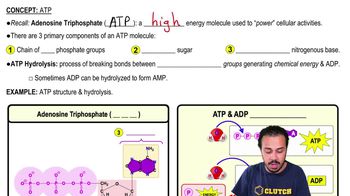
ATP and Muscle Contraction

ATP is crucial for muscle contraction as it provides the energy needed for myosin heads to detach from actin filaments and re-cock for another cycle of movement. Without ATP, myosin remains bound to actin, preventing further contraction cycles. Thus, ATP presence is essential for continuous muscle contraction.
Video consigliato:

Role of Calcium Ions (Ca2+) in Muscle Contraction

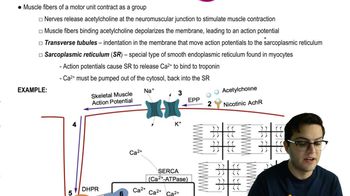
Calcium ions play a pivotal role in muscle contraction by binding to troponin, which causes a conformational change that moves tropomyosin away from actin's binding sites. This exposure allows myosin to bind to actin, facilitating contraction. High intracellular Ca2+ concentration is necessary for sustained muscle contraction.
Video consigliato:
03:14
Motor Unit and Neuromuscular Junction

Troponin and Tropomyosin Regulation

Troponin and tropomyosin are regulatory proteins that control muscle contraction. Troponin binds to Ca2+, leading to tropomyosin's repositioning, which exposes actin's binding sites for myosin. This regulation ensures that muscle contraction occurs only when Ca2+ is present, preventing unwanted contractions.
Video consigliato:
03:31
Cell Cycle Regulation