Ch. 51 - Population Ecology
Freeman - Biological Science 8th Edition
Freeman8th EditionBiological ScienceISBN: 9780138276263Non è quello che usi tu?Cambia libro di testo
Capitolo 51, Problema 6

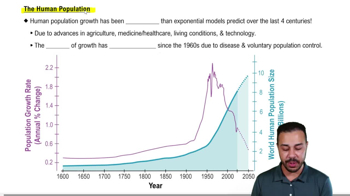
Pose a hypothesis to explain why the human population has undergone especially rapid growth over the past 200 years. Describe two examples of density-dependent factors that limit human population growth. Is it possible that humans have surpassed Earth's carrying capacity?

Guida verificata passo dopo passo
1
Step 1: Formulate a hypothesis to explain the rapid growth of the human population over the past 200 years. A possible hypothesis could be: 'The rapid growth of the human population over the past 200 years is due to advancements in technology and medicine, which have led to increased food production and decreased mortality rates.'
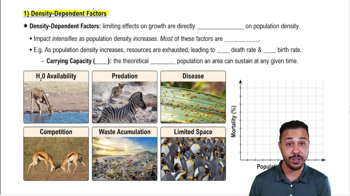
Step 2: Describe two examples of density-dependent factors that limit human population growth. Density-dependent factors are factors whose effects on the size or growth of the population vary with the population density. One example could be 'Disease': As population density increases, the rate of transmission of diseases also increases, potentially leading to a decrease in population size. Another example could be 'Competition for resources': As the population grows, the demand for resources such as food, water, and space also increases. This can lead to a decrease in the availability of these resources, limiting the population growth.
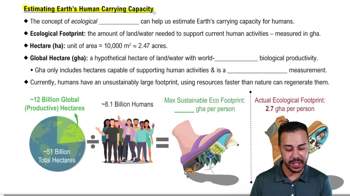
Step 3: Discuss whether it is possible that humans have surpassed Earth's carrying capacity. Carrying capacity refers to the maximum number of individuals of a particular species that an environment can support indefinitely. You could say, 'Given the current rate of resource consumption and waste production, some scientists argue that humans have already surpassed Earth's carrying capacity. However, others believe that technological advancements can help us increase the Earth's carrying capacity by improving resource use efficiency and reducing waste.'
Step 4: Support your arguments with evidence. For example, you could cite statistics on population growth, resource consumption, and waste production. You could also refer to scientific studies that have investigated these issues.
Step 5: Conclude your discussion by summarizing your main points and suggesting areas for further research. For example, you could say, 'While it is clear that the human population has grown rapidly over the past 200 years due to advancements in technology and medicine, it is less clear whether we have surpassed Earth's carrying capacity. Further research is needed to determine the sustainable human population size and develop strategies for achieving it.'

Risposta video verificata per un problema simile:

Questa soluzione video è stata consigliata dai nostri tutor come utile per risolvere questo problema.
Durata del video:
47s

Concetti chiave

Ecco i concetti essenziali che devi comprendere per rispondere correttamente alla domanda.

Human Population Growth

Human population growth refers to the increase in the number of individuals in a population over time. Over the past 200 years, this growth has accelerated due to factors such as advancements in medicine, agriculture, and sanitation, which have significantly reduced mortality rates and increased life expectancy. Understanding this growth is crucial for analyzing its implications on resources and the environment.
Video consigliato:
02:58
The Human Population

Density-Dependent Factors

Density-dependent factors are environmental influences that affect population growth in relation to the population's density. Examples include competition for resources, such as food and water, and the spread of diseases, which become more pronounced as population density increases. These factors can limit population growth by increasing mortality rates or decreasing birth rates when resources become scarce.
Video consigliato:
02:37
Density-Dependent Factors

Carrying Capacity

Carrying capacity is the maximum number of individuals of a species that an environment can sustainably support without degrading the habitat. For humans, this concept raises questions about resource consumption, environmental impact, and sustainability. If the human population exceeds Earth's carrying capacity, it could lead to resource depletion, habitat destruction, and increased conflict over remaining resources.
Video consigliato:
06:24
Estimating Earth’s Human Carrying Capacity
Pratica correlata
Domanda del libro di testo

Why is there a trade-off between survivorship and fecundity?

1149
views
Domanda del libro di testo

If most individuals in a population are young, why is the population likely to grow rapidly in the future?

a. Death rates will be low.

b. The population has a skewed age distribution.

c. Immigration and emigration can be ignored.

d. Many individuals will begin to reproduce soon.

1620
views
Domanda del libro di testo

Which of the following species is most likely to have a Type III survivorship curve?

a. Humans, Homo sapiens

b. Common lizards, Zootoca vivipara

c. Thale cress plants, Arabidopsis thaliana

d. Lynx cats, Lynx canadensis

1166
views
Domanda del libro di testo

When wild plant and animal populations are logged, fished, or hunted, only the oldest or largest individuals tend to be taken. Many of the commercially important species are long lived and are slow to begin reproducing. If harvesting is not regulated carefully and exploitation is intense, what impact does harvesting have on a population's age structure? How might harvesting affect the population's life table and growth rate?

1079
views
Domanda del libro di testo

Indicate what is correct and incorrect about this statement: If lizards want to survive during climate change, they can evolve new life-history traits.

874
views
Domanda del libro di testo

Explain why biologists want to maintain (a) 'habitat corridors' that connect populations in a metapopulation, and (b) unoccupied habitat that is appropriate for the species in question.

741
views