How does the hydrolysis of ATP result in the movement of a motor protein along a cytoskeletal filament?
Ch. 7 - Inside the Cell
Freeman8th EditionBiological ScienceISBN: 9780138276263Non è quello che usi tu?Cambia libro di testo
Capitolo 7, Problema 1
What are three attributes of mitochondria and chloroplasts that suggest they were once free-living bacteria?
Guida verificata passo dopo passo1
Mitochondria and chloroplasts have their own DNA, which is circular and similar to bacterial DNA. This suggests that they could replicate their DNA and function independently like bacteria.
Both mitochondria and chloroplasts have double membranes, which supports the endosymbiotic theory. The theory proposes that these organelles were originally free-living bacteria that were engulfed by early eukaryotic cells.
Mitochondria and chloroplasts have their own ribosomes, which are more similar in size and structure to bacterial ribosomes than to those found in the cytoplasm of eukaryotic cells. This indicates they could synthesize their own proteins independently, like bacteria.
These organelles reproduce by a process similar to binary fission, which is characteristic of bacteria. This mode of reproduction is different from the division processes typically seen in eukaryotic cells, such as mitosis and meiosis.
Both mitochondria and chloroplasts are involved in energy metabolism, with mitochondria being crucial for cellular respiration and chloroplasts essential for photosynthesis. These processes are similar to those carried out by free-living bacteria, further suggesting a bacterial origin.

Risposta video verificata per un problema simile:
Questa soluzione video è stata consigliata dai nostri tutor come utile per risolvere questo problema.
Durata del video:
3mConcetti chiave
Ecco i concetti essenziali che devi comprendere per rispondere correttamente alla domanda.
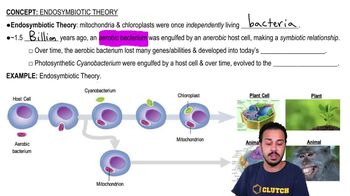
Endosymbiotic Theory
The endosymbiotic theory posits that mitochondria and chloroplasts originated from free-living bacteria that were engulfed by ancestral eukaryotic cells. This theory explains how these organelles retained their own DNA and double membranes, suggesting a symbiotic relationship that evolved over time.
Video consigliato:
Endosymbiotic Theory
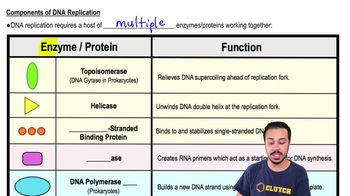
DNA Structure and Replication
Mitochondria and chloroplasts contain their own circular DNA, similar to bacterial DNA, which is distinct from the linear DNA found in the nucleus of eukaryotic cells. This DNA replicates independently of the cell's nuclear DNA, further supporting the idea that these organelles were once independent organisms.
Video consigliato:
Components of DNA Replication
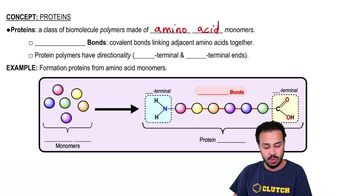
Ribosomes and Protein Synthesis
Both mitochondria and chloroplasts possess their own ribosomes, which are more similar to prokaryotic ribosomes than to those found in eukaryotic cells. This allows them to synthesize some of their own proteins, indicating a level of autonomy consistent with their bacterial ancestry.
Video consigliato:
Proteins
Pratica correlata
Domanda del libro di testo
2075
views
Domanda del libro di testo
Molecular zip codes direct molecules to particular destinations in the cell. How are these signals read?
a. They bind to receptor proteins.
b. They enter transport vesicles.
c. They bind to motor proteins.
d. They are glycosylated by enzymes.
2200
views
Domanda del libro di testo
Which of the following results provided evidence of a discrete nuclear localization signal somewhere on the nucleoplasmin protein?
a. The nucleoplasmin protein was small and easily slipped through the nuclear pore complex.
b. After cleavage of the nucleoplasmin protein, only the tail segments appeared in the nucleus.
c. Removing the tail from the nucleoplasmin protein allowed the core segment to enter the nucleus.
d. The SRP bound only to the tail of the nucleoplasmin protein, not the core segment.
1868
views