Explain how feedback inhibition regulates metabolic pathways.
Ch. 8 - Energy and Enzymes: An Introduction to Metabolism
Freeman8th EditionBiological ScienceISBN: 9780138276263Non è quello che usi tu?Cambia libro di testo
Tutti i libri di testo
Freeman 8th Edition
Ch. 8 - Energy and Enzymes: An Introduction to Metabolism
Problema 1
Freeman 8th Edition
Ch. 8 - Energy and Enzymes: An Introduction to Metabolism
Problema 1Capitolo 8, Problema 1
Which of the following correctly describe an exergonic reaction? Select True or False for each statement.
T/F The products have lower Gibbs free energy than the reactants.
T/F Activation energy is required for the reaction to proceed.
T/F The products always have lower entropy than the reactants.
T/F The reaction always occurs quickly.
Guida verificata passo dopo passo1
Understand the concept of an exergonic reaction: An exergonic reaction is a chemical reaction where the change in Gibbs free energy (
) is negative, indicating that the reaction releases energy.
Evaluate the statement about Gibbs free energy: In an exergonic reaction, the products have lower Gibbs free energy than the reactants because energy is released during the reaction. This statement is true.
Consider the role of activation energy: Even though exergonic reactions release energy, they often require an initial input of energy to overcome the activation energy barrier. This statement is true.
Analyze the statement about entropy: Exergonic reactions do not necessarily result in products with lower entropy. Entropy can increase or decrease depending on the specific reaction. This statement is false.
Assess the speed of the reaction: The speed of an exergonic reaction is not determined solely by its exergonic nature. Other factors, such as the presence of catalysts, affect reaction speed. This statement is false.

Risposta video verificata per un problema simile:
Questa soluzione video è stata consigliata dai nostri tutor come utile per risolvere questo problema.
Durata del video:
2mConcetti chiave
Ecco i concetti essenziali che devi comprendere per rispondere correttamente alla domanda.
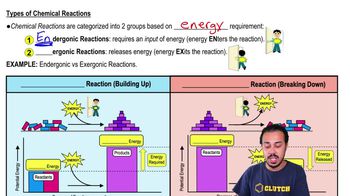
Exergonic Reaction
An exergonic reaction is a chemical process where the Gibbs free energy of the products is lower than that of the reactants, indicating that energy is released during the reaction. This release of energy makes the reaction spontaneous under constant temperature and pressure conditions.
Video consigliato:
Types of Chemical Reactions
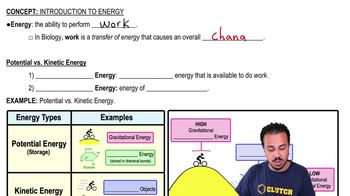
Gibbs Free Energy
Gibbs free energy is a thermodynamic quantity that combines enthalpy and entropy to predict the feasibility of a reaction. In exergonic reactions, the change in Gibbs free energy (ΔG) is negative, signifying that the reaction releases energy and can occur spontaneously.
Video consigliato:
Introduction to Energy
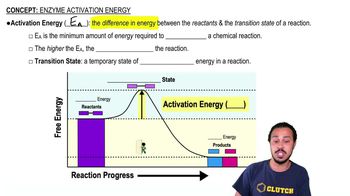
Activation Energy
Activation energy is the minimum energy required to initiate a chemical reaction. Even in exergonic reactions, activation energy is needed to overcome the energy barrier and allow the reactants to transform into products, despite the overall energy release.
Video consigliato:
Enzyme Activation Energy
Pratica correlata
Domanda del libro di testo
1535
views
Domanda del libro di testo
What is a transition state?
a. The shape adopted by an enzyme that has an inhibitory molecule bound at its active site
b. The amount of kinetic energy required for a reaction to proceed
c. The intermediate complex formed as covalent bonds in the reactants are being broken and re-formed during a reaction
d. The enzyme shape after binding an allosteric regulatory molecule
2506
views
Domanda del libro di testo
How does pH affect enzyme-catalyzed reactions?
a. Protons serve as substrates for most reactions.
b. Energy stored in protons is used to drive endergonic reactions.
c. Proton concentration increases the kinetic energy of the reactants, enabling them to reach their transition state.
d. The concentration of protons affects an enzyme's folded structure and reactivity.
2429
views