Skip to main content
Statistics for Business
Il mio corso
Impara
Preparazione agli esami
AI Tutor
Guide di studio
Flashcard
Esplora
Prova l'app
Il mio corso
Impara
Preparazione agli esami
AI Tutor
Guide di studio
Flashcard
Esplora
Prova l'app
Indietro
Bayes' Theorem quiz
Puoi toccare per girare la carta.
What does conditional probability allow us to determine?
Puoi toccare per girare la carta.
👆
What does conditional probability allow us to determine?
Conditional probability allows us to find the likelihood of an event occurring given that another event has already occurred.
Avanzamenti del tracciato
I pulsanti di controllo sono stati cambiati in modalità "navigazione".
1/15
Flashcard correlate
Pratica correlata
Video consigliati
Bayes' Theorem definitions
Bayes' Theorem
15 Termini
Bayes' Theorem
4. Probability
7 Problemi
Argomento
Ally
Fundamental Counting Principle
4. Probability
10 Problemi
Argomento
Ernest
4. Probability
9 Argomenti
17 Problemi
Capitolo
Ernest
VideoThumbView.guidedCourse
05:10
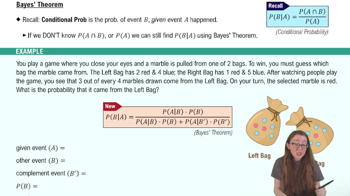
Bayes' Theorem
512
views
12
rank
VideoThumbView.guidedCourse
02:32
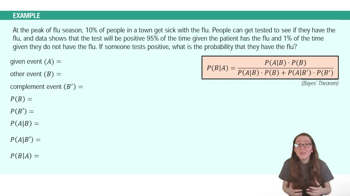
Bayes' Theorem Example 1
277
views
6
rank
Termini in questo insieme (15)
Nascondere definizioni
What does conditional probability allow us to determine?
Conditional probability allows us to find the likelihood of an event occurring given that another event has already occurred.
What is the main purpose of Bayes' theorem in probability?
Bayes' theorem relates the probabilities of two events, simplifying the calculation of conditional probabilities.
In Bayes' theorem, what does the numerator represent?
The numerator represents the joint probability of both events A and B occurring.
What does the denominator in Bayes' theorem represent?
The denominator is the probability of the given event, usually event A.
Why might Bayes' theorem be easier to use than the conditional probability rule in some problems?
Bayes' theorem can be easier when direct probabilities for events are not given, but related probabilities are available.
In the marble example, what is the 'given' event (event A)?
The given event is that the selected marble is red.
What is event B in the marble example?
Event B is that the marble came from the left bag.
What is the complement of event B in the marble example?
The complement of event B is that the marble came from the right bag.
How do you calculate the probability of drawing from the left bag in the example?
The probability is three out of four, since three out of every four marbles drawn come from the left bag.
What is the probability of drawing from the right bag in the example?
The probability is one out of four, as it is the complement of drawing from the left bag.
How do you find the probability of drawing a red marble given it came from the left bag?
It is two out of six, since two of the six marbles in the left bag are red.
What is the probability of drawing a red marble given it came from the right bag?
It is one out of six, since only one of the six marbles in the right bag is red.
What formula do you use to find the probability of the marble coming from the left bag given it is red?
You use Bayes' theorem, plugging in the relevant probabilities for each event and their complements.
What is the final probability that the marble came from the left bag given it is red?
The probability is six sevenths, after simplifying the fractions in Bayes' theorem.
Why is it important to correctly identify which event is 'given' in conditional probability problems?
Correctly identifying the 'given' event ensures you use the right probabilities in Bayes' theorem and conditional probability calculations.
 IndietroIndietro

 05:10
05:10