Skip to main content
Statistics for Business
Il mio corso
Impara
Preparazione agli esami
AI Tutor
Guide di studio
Flashcard
Esplora
Prova l'app
Il mio corso
Impara
Preparazione agli esami
AI Tutor
Guide di studio
Flashcard
Esplora
Prova l'app
Indietro
Intro to Collecting Data quiz
Puoi toccare per girare la carta.
What are the two major methods for collecting data in studies?
Puoi toccare per girare la carta.
👆
What are the two major methods for collecting data in studies?
The two major methods are experiments and observational studies.
Avanzamenti del tracciato
I pulsanti di controllo sono stati cambiati in modalità "navigazione".
1/15
Flashcard correlate
Pratica correlata
Video consigliati
Intro to Collecting Data definitions
Intro to Collecting Data
15 Termini
Intro to Collecting Data
1. Introduction to Statistics
10 Problemi
Argomento
Ernest
Sampling Methods
1. Introduction to Statistics
10 Problemi
Argomento
Ally
1. Introduction to Statistics
3 Argomenti
15 Problemi
Capitolo
Brendan
VideoThumbView.guidedCourse
4:01
Introduction to Collecting Data
1168
views
38
rank
Termini in questo insieme (15)
Nascondere definizioni
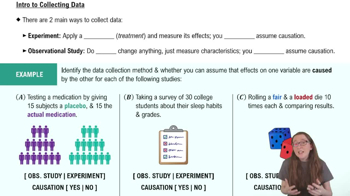
What are the two major methods for collecting data in studies?
The two major methods are experiments and observational studies.
In an experiment, what is typically applied to measure its effects?
A treatment or controlled change is applied to measure its effects.
What can we assume in an experiment if we notice a difference in results?
We can assume causation, meaning the difference is due to the treatment.
What is the main characteristic of an observational study?
No changes or treatments are applied; characteristics are simply observed as they are.
Can we assume causation in an observational study? Why or why not?
No, because we are not manipulating any variables, so we cannot determine cause and effect.
Give an example of an experiment from the transcript.
Testing a medication by giving 15 subjects a placebo and 15 the actual medication.
Why is giving a placebo to one group and medication to another considered an experiment?
Because a treatment (medication) is applied and its effects are measured against a control (placebo).
What type of study is taking a survey of students about their sleep habits and grades?
It is an observational study.
Why can't we assume causation from a survey about sleep habits and grades?
Because we are only observing existing characteristics without manipulating any variables.
What does the act of 'comparing' results between two different conditions often indicate about a study?
It often indicates that the study is an experiment, as something is being changed or manipulated.
In the example of rolling a fair die and a loaded die, what type of study is this and why?
It is an experiment because the type of die is changed and the results are compared.
What is a placebo and why is it used in experiments?
A placebo is a fake treatment used as a control to compare the effects of the actual treatment.
What is the key difference between experiments and observational studies regarding variable manipulation?
Experiments involve manipulating variables, while observational studies do not.
How does the method of data collection affect the conclusions we can draw from a study?
It determines whether we can infer causation (experiments) or only observe associations (observational studies).
Why is understanding the distinction between experiments and observational studies important in statistics?
Because it affects how we interpret results and apply statistical principles like the Central Limit Theorem and confidence intervals.
 IndietroIndietro


 4:01
4:01