Skip to main content
Statistics for Business
Il mio corso
Impara
Preparazione agli esami
AI Tutor
Guide di studio
Flashcard
Esplora
Prova l'app
Il mio corso
Impara
Preparazione agli esami
AI Tutor
Guide di studio
Flashcard
Esplora
Prova l'app
Indietro
Multiple Comparisons: Tukey Test quiz
Puoi toccare per girare la carta.
What is the main purpose of post hoc tests like the Tukey test after an ANOVA?
Puoi toccare per girare la carta.
👆
What is the main purpose of post hoc tests like the Tukey test after an ANOVA?
Post hoc tests identify which specific means are different after an ANOVA rejects the null hypothesis.
Avanzamenti del tracciato
I pulsanti di controllo sono stati cambiati in modalità "navigazione".
1/15
Flashcard correlate
Pratica correlata
Video consigliati
Multiple Comparisons: Tukey Test definitions
Multiple Comparisons: Tukey Test
15 Termini
Multiple Comparisons: Tukey-Kramer Test
14. ANOVA
5 Problemi
Argomento
Justin
14. ANOVA - Part 1 of 2
1 Argomento
15 Problemi
Capitolo
Ally
14. ANOVA - Part 2 of 2
3 Argomenti
9 Problemi
Capitolo
Justin
VideoThumbView.guidedCourse
08:22
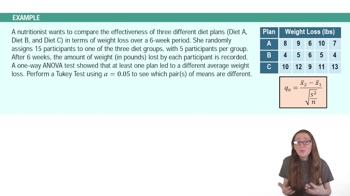
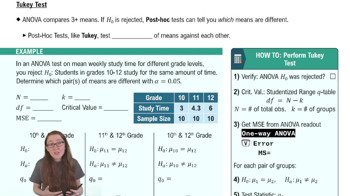
Tukey Test
211
views
VideoThumbView.guidedCourse
05:55
Tukey Test Example 1
149
views
1
rank
Termini in questo insieme (15)
Nascondere definizioni
What is the main purpose of post hoc tests like the Tukey test after an ANOVA?
Post hoc tests identify which specific means are different after an ANOVA rejects the null hypothesis.
What does the Tukey test compare in its analysis?
The Tukey test compares all possible pairs of group means to determine which pairs are significantly different.
What must be true about the ANOVA result before performing a Tukey test?
You must have rejected the null hypothesis in the ANOVA, indicating at least one mean is different.
What distribution is used to find the critical value for the Tukey test?
The studentized range distribution (q table) is used to find the critical value for the Tukey test.
How do you calculate the degrees of freedom for the Tukey test?
Degrees of freedom are calculated as the total number of observations minus the number of groups.
If you have 30 observations and 3 groups, what is the degrees of freedom for the Tukey test?
The degrees of freedom would be 30 minus 3, which equals 27.
What value from the ANOVA output is used as s squared (variance) in the Tukey test formula?
The mean square due to error (MSE) from the ANOVA output is used as s squared in the Tukey test formula.
What is the null hypothesis for each pairwise comparison in the Tukey test?
The null hypothesis is that the two group means being compared are equal.
How do you calculate the numerator of the Tukey test statistic for a pair of groups?
The numerator is the difference between the two group means being compared.
What do you do if your calculated q statistic is less than the critical value in the Tukey test?
If the q statistic is less than the critical value, you fail to reject the null hypothesis for that pair.
What does it mean if your q statistic is greater than the critical value in the Tukey test?
If the q statistic is greater than the critical value, you reject the null hypothesis and conclude the means are different.
What is the significance level (alpha) commonly used in the Tukey test, as shown in the example?
A significance level (alpha) of 0.05 is commonly used.
Why can't you get a p-value directly from the q table in the Tukey test?
The q table provides only critical values, not p-values, so you must use a critical value comparison.
What is the alternative hypothesis in each pairwise Tukey test?
The alternative hypothesis is that the two group means being compared are not equal.
What conclusion can you draw if you fail to reject the null hypothesis for a pair in the Tukey test?
You conclude that there is no significant difference between the means of those two groups.
 IndietroIndietro

 08:22
08:22