Skip to main content
Statistics for Business
Il mio corso
Impara
Preparazione agli esami
AI Tutor
Guide di studio
Flashcard
Esplora
Prova l'app
Il mio corso
Impara
Preparazione agli esami
AI Tutor
Guide di studio
Flashcard
Esplora
Prova l'app
Indietro
Multiplication Rule: Dependent Events quiz
Puoi toccare per girare la carta.
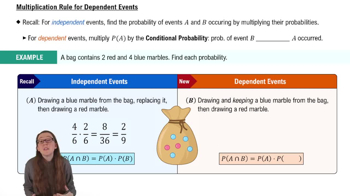
What is the formula for finding the probability of two dependent events?
Puoi toccare per girare la carta.
👆
What is the formula for finding the probability of two dependent events?
The formula is P(A and B) = P(A) × P(B | A), where P(B | A) is the conditional probability of B given A.
Avanzamenti del tracciato
I pulsanti di controllo sono stati cambiati in modalità "navigazione".
1/15
Flashcard correlate
Pratica correlata
Video consigliati
Multiplication Rule: Dependent Events definitions
Multiplication Rule: Dependent Events
15 Termini
Multiplication Rule: Dependent Events
4. Probability
10 Problemi
Argomento
Brendan
Bayes' Theorem
4. Probability
7 Problemi
Argomento
Ally
4. Probability
9 Argomenti
17 Problemi
Capitolo
Ernest
VideoThumbView.guidedCourse
02:46
Multiplication Rule: Dependent Events Example 1
360
views
7
rank
05:17
Multiplication Rule: Dependent Events
520
views
17
rank
VideoThumbView.guidedCourse
03:25
Conditional Probability Rule Example 3
290
views
11
rank
Termini in questo insieme (15)
Nascondere definizioni
What is the formula for finding the probability of two dependent events?
The formula is P(A and B) = P(A) × P(B | A), where P(B | A) is the conditional probability of B given A.
How does the probability calculation change when events are dependent?
You must use the conditional probability for the second event, since its likelihood depends on the outcome of the first event.
What is a conditional probability?
Conditional probability is the probability of event B occurring given that event A has already occurred.
How do you write the conditional probability of B given A?
It is written as P(B | A) and read as 'the probability of B given A.'
In the marble example, what is the probability of drawing a blue marble first?
The probability is 4/6, since there are four blue marbles out of six total.
After drawing and keeping a blue marble, what is the probability of drawing a red marble next?
The probability is 2/5, because there are two red marbles left out of five total marbles.
What is the probability of drawing and keeping a blue marble, then drawing a red marble?
It is (4/6) × (2/5) = 8/30, which simplifies to 4/15.
Why do you use conditional probability in dependent events?
Because the outcome of the first event affects the probability of the second event.
What is the conditional probability rule formula?
P(B | A) = P(A and B) / P(A).
In the survey example, what is event A?
Event A is the student having a science major, since it is the given condition.
How do you identify which event is A and which is B in conditional probability problems?
Event A is the given event or the one you know happened; event B is the other event of interest.
What is the probability that a student has a science major in the survey example?
It is 15/40, since 15 out of 40 students have a science major.
What is the probability that a student has both a math and science major?
It is 8/40, because 8 students have both majors out of 40 surveyed.
How do you calculate the probability that a student has a math major given they have a science major?
Divide the probability of having both majors (8/40) by the probability of having a science major (15/40), resulting in 8/15.
Why is understanding conditional probability important in real-world scenarios?
It helps accurately analyze situations where events are related, such as surveys or experiments, by considering how one event affects another.
 IndietroIndietro


 02:46
02:46