Skip to main content
Statistics for Business
Il mio corso
Impara
Preparazione agli esami
AI Tutor
Guide di studio
Flashcard
Esplora
Prova l'app
Il mio corso
Impara
Preparazione agli esami
AI Tutor
Guide di studio
Flashcard
Esplora
Prova l'app
Indietro
Two Means - Unknown, Unequal Variance definitions
Puoi toccare per girare la carta.
Null Hypothesis
Puoi toccare per girare la carta.
👆
Null Hypothesis
Default claim that two population means are equal, often represented as their difference being zero.
Avanzamenti del tracciato
I pulsanti di controllo sono stati cambiati in modalità "navigazione".
1/15
Flashcard correlate
Pratica correlata
Video consigliati
Two Means - Unknown, Unequal Variance quiz
Two Means - Unknown, Unequal Variance
15 Termini
Two Means - Unknown, Unequal Variance
10. Hypothesis Testing for Two Samples
10 Problemi
Argomento
Ally
10. Hypothesis Testing for Two Samples - Part 1 of 2
3 Argomenti
15 Problemi
Capitolo
Ally
10. Hypothesis Testing for Two Samples - Part 2 of 2
3 Argomenti
8 Problemi
Capitolo
Justin
VideoThumbView.guidedCourse
08:21
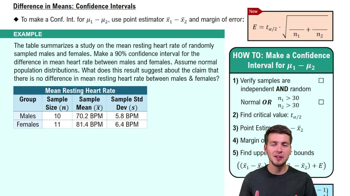
Difference in Means: Confidence Intervals
170
views
VideoThumbView.guidedCourse
05:22
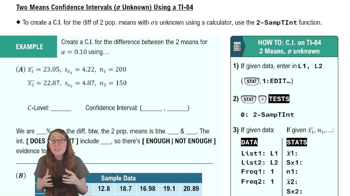
Difference in Means: Confidence Intervals Using TI-84
123
views
VideoThumbView.guidedCourse
07:32
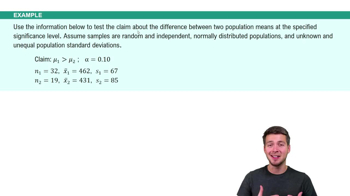
Difference in Means: Hypothesis Tests Example 1
176
views
3
rank
Termini in questo insieme (15)
Nascondere definizioni
Null Hypothesis
Default claim that two population means are equal, often represented as their difference being zero.
Alternative Hypothesis
Statement suggesting a difference exists between two population means, challenging the default claim.
T-Distribution
Probability distribution used when population standard deviations are unknown, especially with small samples.
Degrees of Freedom
Value based on sample sizes, typically the smaller sample size minus one, used to reference t-tables.
P Value
Probability of observing a test statistic as extreme as, or more extreme than, the one calculated, under the null.
Alpha
Threshold probability for significance, often set at 0.05, used to decide whether to reject the null hypothesis.
Confidence Interval
Range of values, derived from sample data, likely to contain the true difference between two population means.
Point Estimator
Best guess for the difference in population means, calculated as the difference between sample means.
Margin of Error
Amount added and subtracted from the point estimator to create the confidence interval, incorporating variability.
Sample Standard Deviation
Measure of spread within each sample, used when population standard deviations are unknown.
Two-Tailed Test
Hypothesis test where evidence for difference is considered in both directions from the null value.
Random Sample
Subset of a population selected so that every member has an equal chance of being chosen, ensuring unbiased results.
Independence
Condition where the outcome of one sample does not affect the outcome of the other, crucial for valid inference.
Critical Value
Cutoff from the t-distribution, based on confidence level and degrees of freedom, used in margin of error calculation.
Pooled Variance
Concept indicating whether variances are assumed equal; in this context, variances are not pooled.
 IndietroIndietro

 08:21
08:21