Skip to main content
Calculus
Il mio corso
Impara
Preparazione agli esami
AI Tutor
Guide di studio
Soluzioni per libri di testo
Flashcard
Esplora
Prova l'app
Il mio corso
Impara
Preparazione agli esami
AI Tutor
Guide di studio
Soluzioni per libri di testo
Flashcard
Esplora
Prova l'app
Indietro
Average Value of a Function quiz #1
Puoi toccare per girare la carta.
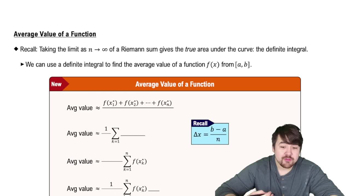
What is the formula for finding the average value of a function f(x) over the interval [a, b]?
Puoi toccare per girare la carta.
👆
What is the formula for finding the average value of a function f(x) over the interval [a, b]?
The average value is given by (1/(b - a)) ∫[a to b] f(x) dx.
Avanzamenti del tracciato
I pulsanti di controllo sono stati cambiati in modalità "navigazione".
1/11
Flashcard correlate
Pratica correlata
Video consigliati
Average Value of a Function definitions
Average Value of a Function
15 Termini
Average Value of a Function
8. Definite Integrals
5 Problemi
Argomento
Ernest
Substitution
8. Definite Integrals
5 Problemi
Argomento
Ernest
8. Definite Integrals - Part 1 of 2
5 Argomenti
14 Problemi
Capitolo
Ernest
8. Definite Integrals - Part 2 of 2
1 Argomento
3 Problemi
Capitolo
Ernest
VideoThumbView.guidedCourse
04:25
Average Value of a Function Example 1
464
views
19
rank
VideoThumbView.guidedCourse
06:37
Average Value of a Function
842
views
18
rank
1
comments
Termini in questo insieme (11)
Nascondere definizioni
What is the formula for finding the average value of a function f(x) over the interval [a, b]?
The average value is given by (1/(b - a)) ∫[a to b] f(x) dx.
Explain in your own words what the average value of a function over an interval represents.
It represents the mean output of the function for all input values between a and b.
How does the definite integral help in finding the average value of a function?
The definite integral sums all function values over the interval, and dividing by the interval's length gives the average.
Why can't we simply add up all the function values and divide by the number of values to find the average value of a continuous function?
Because there are infinitely many input values in a continuous interval, making direct summation impossible.
Describe the connection between Riemann sums and the formula for the average value of a function.
The average value formula is derived from the limit of Riemann sums as the number of subintervals approaches infinity.
If f(x) = x + 2 on the interval [0, 4], what is the average value of f(x) over this interval?
The average value is 4.
What does the term (1/(b - a)) represent in the average value formula?
It represents dividing by the length of the interval to find the mean value.
How do you evaluate the definite integral in the average value formula?
Find the antiderivative of f(x), evaluate it at b and a, and subtract: F(b) - F(a).
What is the role of the Fundamental Theorem of Calculus in finding the average value of a function?
It allows us to compute the definite integral by evaluating the antiderivative at the interval's endpoints.
If the average value of a function on [a, b] is A, what does this tell you about the function's behavior on that interval?
It tells you the constant value that would yield the same total area under the curve as the original function over [a, b].
Why is the process of finding the average value of a function simplified by using integrals instead of direct computation?
Integrals efficiently sum infinitely many values, making it possible to calculate the average for continuous functions.
 IndietroIndietro
 04:25
04:25