Skip to main content
Calculus
Il mio corso
Impara
Preparazione agli esami
AI Tutor
Guide di studio
Soluzioni per libri di testo
Flashcard
Esplora
Prova l'app
Il mio corso
Impara
Preparazione agli esami
AI Tutor
Guide di studio
Soluzioni per libri di testo
Flashcard
Esplora
Prova l'app
Indietro
Basic Graphing of the Derivative quiz
Puoi toccare per girare la carta.
What does the derivative of a function represent on its graph?
Puoi toccare per girare la carta.
👆
What does the derivative of a function represent on its graph?
The derivative represents the slope of the tangent line to the function's graph at each point.
Avanzamenti del tracciato
I pulsanti di controllo sono stati cambiati in modalità "navigazione".
1/15
Flashcard correlate
Pratica correlata
Video consigliati
Basic Graphing of the Derivative definitions
Basic Graphing of the Derivative
15 Termini
Basic Graphing of the Derivative
2. Intro to Derivatives
3 Problemi
Argomento
Ally
Differentiability
2. Intro to Derivatives
3 Problemi
Argomento
David-Paige
2. Intro to Derivatives
4 Argomenti
7 Problemi
Capitolo
Jonathan
VideoThumbView.guidedCourse
04:24
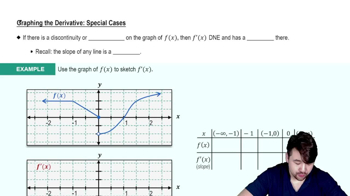
Graphing The Derivative - Special Cases
1590
views
31
rank
VideoThumbView.guidedCourse
06:15
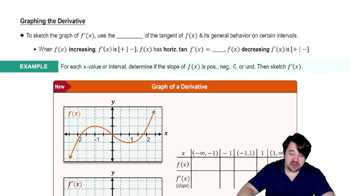
Graphing The Derivative
2400
views
45
rank
VideoThumbView.guidedCourse
03:29
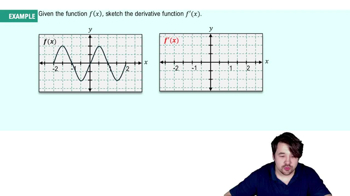
Graphing The Derivative Example 1
1474
views
32
rank
Termini in questo insieme (15)
Nascondere definizioni
What does the derivative of a function represent on its graph?
The derivative represents the slope of the tangent line to the function's graph at each point.
How can you determine where the derivative of a function is zero by looking at its graph?
The derivative is zero at points where the graph has a flat (horizontal) tangent line, such as peaks, valleys, or flat sections.
What does a positive derivative indicate about the behavior of the original function?
A positive derivative means the function is increasing at that interval.
What does a negative derivative indicate about the behavior of the original function?
A negative derivative means the function is decreasing at that interval.
What is the value of the derivative for a constant (horizontal) section of a function?
The derivative is zero for any constant or horizontal section of a function.
What happens to the derivative at a sharp corner or cusp in the graph of a function?
The derivative does not exist at sharp corners or cusps, resulting in a jump or hole in the derivative graph.
How do you identify intervals where the derivative is positive or negative on a graph?
Intervals where the graph is going uphill have a positive derivative, and intervals going downhill have a negative derivative.
What is the significance of a discontinuity in the original function for its derivative?
At a discontinuity, the derivative does not exist, so there is a jump or hole in the derivative graph at that point.
How can you efficiently sketch the derivative of a function without calculating every tangent line?
By analyzing the general behavior of the function—where it increases, decreases, or is flat—you can sketch the derivative efficiently.
Where does the graph of the derivative cross the x-axis?
The derivative graph crosses the x-axis at points where the original function has a horizontal tangent line (slope zero).
What does a constant nonzero derivative indicate about the original function?
A constant nonzero derivative means the original function is a straight line with constant slope.
How does the derivative behave near a local maximum or minimum of the original function?
The derivative is zero at the exact point of a local maximum or minimum.
What should you do on the derivative graph at points where the original function has a jump?
You should place a hole or discontinuity on the derivative graph at those points, since the derivative does not exist there.
How does the steepness of the original function affect the value of its derivative?
The steeper the function (uphill or downhill), the larger the absolute value of the derivative.
What is the main rule to remember when sketching the derivative at sharp corners or discontinuities?
At sharp corners or discontinuities, the derivative does not exist, so the derivative graph has a jump or hole at those points.
 IndietroIndietro
 04:24
04:24