Skip to main content
Calculus
Il mio corso
Impara
Preparazione agli esami
AI Tutor
Guide di studio
Soluzioni per libri di testo
Flashcard
Esplora
Prova l'app
Il mio corso
Impara
Preparazione agli esami
AI Tutor
Guide di studio
Soluzioni per libri di testo
Flashcard
Esplora
Prova l'app
Indietro
Calculus in Polar Coordinates quiz
Puoi toccare per girare la carta.
What is the general form for expressing a point in polar coordinates?
Puoi toccare per girare la carta.
👆
What is the general form for expressing a point in polar coordinates?
A point in polar coordinates is given as (r, θ), where r is the radial distance from the origin and θ is the angle from the positive x-axis.
Avanzamenti del tracciato
I pulsanti di controllo sono stati cambiati in modalità "navigazione".
1/15
Flashcard correlate
Pratica correlata
Video consigliati
Calculus in Polar Coordinates definitions
Calculus in Polar Coordinates
15 Termini
Calculus in Polar Coordinates
16. Parametric Equations & Polar Coordinates
5 Problemi
Argomento
Ernest
Conic Sections
16. Parametric Equations & Polar Coordinates
5 Problemi
Argomento
Ernest
16. Parametric Equations & Polar Coordinates
5 Argomenti
14 Problemi
Capitolo
Justin
VideoThumbView.guidedCourse
12:18
Area of Polar Regions Example 2
213
views
3
rank
1
comments
VideoThumbView.guidedCourse
09:04
Slope of Polar Curves
264
views
4
rank
VideoThumbView.guidedCourse
05:58
Slope of Polar Curves Example 1
242
views
4
rank
Termini in questo insieme (15)
Nascondere definizioni
What is the general form for expressing a point in polar coordinates?
A point in polar coordinates is given as (r, θ), where r is the radial distance from the origin and θ is the angle from the positive x-axis.
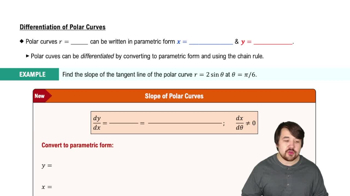
How do you convert a polar curve r = f(θ) into parametric equations for x and y?
Set x = f(θ) cos(θ) and y = f(θ) sin(θ).
What formula is used to find the slope of the tangent line to a polar curve?
The slope is given by dy/dx = (dy/dθ) / (dx/dθ).
When differentiating y = f(θ) sin(θ), what rule do you use?
Use the product rule: derivative of the first times the second plus the first times the derivative of the second.
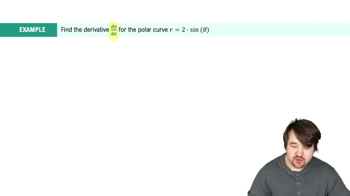
What is the derivative of y = 2 sin²(θ) with respect to θ?
The derivative is 4 sin(θ) cos(θ), which can also be written as 2 sin(2θ).
How do you find dx/dθ if x = 2 sin(θ) cos(θ)?
dx/dθ = 2 cos(2θ), using the double angle identity for sine.
What trigonometric identity allows you to simplify 2 sin(θ) cos(θ)?
2 sin(θ) cos(θ) = sin(2θ).
If dy/dθ = 2 sin(2θ) and dx/dθ = 2 cos(2θ), what is dy/dx?
dy/dx = tan(2θ).
What is the slope of the tangent line to r = 2 sin(θ) at θ = π/6?
The slope is tan(π/3), which equals √3.
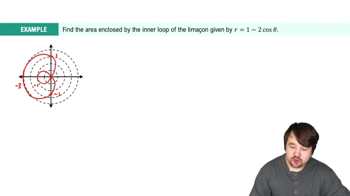
What is the formula for the area of a region bounded by a polar curve r = f(θ) from θ = α to θ = β?
A = (1/2) ∫[α to β] r² dθ.
How do you set up the integral to find the area of one petal of the rose r = 4 sin(2θ)?
Set up the integral as (1/2) ∫[0 to π/2] (4 sin(2θ))² dθ.
What is the value of (4 sin(2θ))²?
It is 16 sin²(2θ).
What trigonometric identity is used to integrate sin²(2θ)?
sin²(2θ) = (1 - cos(4θ))/2.
After applying the identity and simplifying, what does the area integral for one petal of r = 4 sin(2θ) become?
It becomes 4 ∫[0 to π/2] (1 - cos(4θ)) dθ.
What is the area of one petal of the rose curve r = 4 sin(2θ)?
The area is 2π.
 IndietroIndietro
 12:18
12:18