Skip to main content
Calculus
Il mio corso
Impara
Preparazione agli esami
AI Tutor
Guide di studio
Soluzioni per libri di testo
Flashcard
Esplora
Prova l'app
Il mio corso
Impara
Preparazione agli esami
AI Tutor
Guide di studio
Soluzioni per libri di testo
Flashcard
Esplora
Prova l'app
Indietro
Calculus with Parametric Curves quiz
Puoi toccare per girare la carta.
How do you find the derivative dy/dx for parametric equations x(t) and y(t)?
Puoi toccare per girare la carta.
👆
How do you find the derivative dy/dx for parametric equations x(t) and y(t)?
You divide dy/dt by dx/dt, so dy/dx = (dy/dt) / (dx/dt).
Avanzamenti del tracciato
I pulsanti di controllo sono stati cambiati in modalità "navigazione".
1/15
Flashcard correlate
Pratica correlata
Video consigliati
Calculus with Parametric Curves definitions
Calculus with Parametric Curves
15 Termini
Calculus with Parametric Curves
16. Parametric Equations & Polar Coordinates
5 Problemi
Argomento
Polar Coordinates
16. Parametric Equations & Polar Coordinates
5 Problemi
Argomento
Ernest
16. Parametric Equations & Polar Coordinates
5 Argomenti
14 Problemi
Capitolo
Justin
VideoThumbView.guidedCourse
06:38
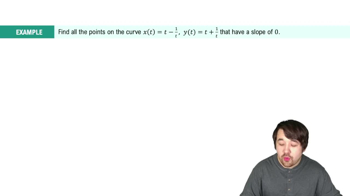
Differentiation of Parametric Curves Example 2
244
views
6
rank
VideoThumbView.guidedCourse
06:40
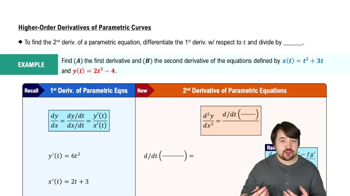
Higher Order Derivatives of Parametric Curves
261
views
7
rank
VideoThumbView.guidedCourse
06:29
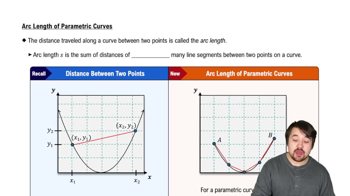
Arc Length of Parametric Curves
240
views
7
rank
Termini in questo insieme (15)
Nascondere definizioni
How do you find the derivative dy/dx for parametric equations x(t) and y(t)?
You divide dy/dt by dx/dt, so dy/dx = (dy/dt) / (dx/dt).
What must be true about dx/dt when finding dy/dx for parametric equations?
dx/dt must not be zero, since division by zero is undefined.
What is the formula for the arc length s of a parametric curve from t = a to t = b?
s = ∫ from a to b of sqrt[(dx/dt)^2 + (dy/dt)^2] dt.
How do you find the second derivative d²y/dx² for parametric equations?
Differentiate the first derivative dy/dx with respect to t, then divide by dx/dt.
What is the geometric meaning of the derivative at a point on a parametric curve?
It represents the slope of the tangent line at that point.
How do you find the equation of the tangent line to a parametric curve at t = t₀?
Find x(t₀), y(t₀), and the slope dy/dx at t₀, then use point-slope form: y - y₀ = m(x - x₀).
What rule is used to differentiate a rational function like dy/dx = f(t)/g(t)?
The quotient rule: [g(t)f'(t) - f(t)g'(t)] / [g(t)]².
How do you find higher-order derivatives (third, fourth, etc.) for parametric curves?
Differentiate the previous derivative with respect to t and divide by dx/dt each time.
What is the relationship between the arc length formula and the distance formula?
The arc length formula sums infinitely many small distances along the curve, similar to the distance formula for two points.
What identity simplifies the arc length integral for x(t) = 2cos(t), y(t) = 2sin(t)?
cos²(t) + sin²(t) = 1, the Pythagorean identity.
What is the arc length of the curve x(t) = 2cos(t), y(t) = 2sin(t) from t = 0 to t = π?
The arc length is 2π.
What is the derivative of x(t) = t² + 3t with respect to t?
dx/dt = 2t + 3.
What is the derivative of y(t) = 2t³ - 4 with respect to t?
dy/dt = 6t².
How do you compute dy/dx at t = 1 for x(t) = t² + 3t and y(t) = 2t³ - 4?
Plug t = 1 into dy/dt and dx/dt, then divide: dy/dx = 6/5.
What is the general process for finding the tangent line to a parametric curve?
Evaluate x and y at the given t, find the slope dy/dx at that t, and use point-slope form to write the equation.
 IndietroIndietro
 06:38
06:38