Skip to main content
Calculus
Il mio corso
Impara
Preparazione agli esami
AI Tutor
Guide di studio
Soluzioni per libri di testo
Flashcard
Esplora
Prova l'app
Il mio corso
Impara
Preparazione agli esami
AI Tutor
Guide di studio
Soluzioni per libri di testo
Flashcard
Esplora
Prova l'app
Indietro
Combining Functions definitions
Puoi toccare per girare la carta.
Function
Puoi toccare per girare la carta.
👆
Function
A rule assigning each input exactly one output, often expressed as f(x), with a specific domain and range.
Avanzamenti del tracciato
I pulsanti di controllo sono stati cambiati in modalità "navigazione".
1/15
Flashcard correlate
Pratica correlata
Video consigliati
Combining Functions quiz
Combining Functions
15 Termini
Combining Functions
0. Functions
4 Problemi
Argomento
Patrick
Exponent rules
0. Functions
5 Problemi
Argomento
Ernest
0. Functions - Part 1 of 2
7 Argomenti
14 Problemi
Capitolo
Patrick
0. Functions - Part 2 of 2
8 Argomenti
12 Problemi
Capitolo
David-Paige
VideoThumbView.guidedCourse
4:26
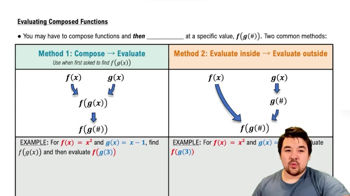
Evaluating Composed Functions
1354
views
36
rank
VideoThumbView.guidedCourse
5:56
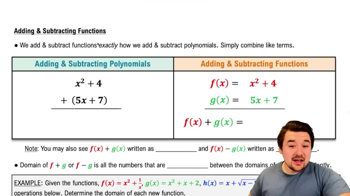
Adding & Subtracting Functions
1900
views
55
rank
VideoThumbView.guidedCourse
4:46
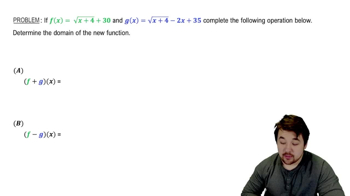
Adding & Subtracting Functions Example 1
1537
views
40
rank
Termini in questo insieme (15)
Nascondere definizioni
Function
A rule assigning each input exactly one output, often expressed as f(x), with a specific domain and range.
Domain
The set of all input values for which a function is defined, often restricted by denominators or square roots.
Range
The set of all possible output values a function can produce based on its domain.
Polynomial
An algebraic expression involving sums of powers of x with real coefficients, such as x² + 5x + 7.
Composition
A process where the output of one function becomes the input of another, denoted as f(g(x)).
Notation
A symbolic representation of mathematical operations, such as f+g(x), f∘g(x), or f/g(x).
Like Terms
Terms in algebraic expressions with identical variable parts, which can be combined during addition or subtraction.
Denominator
The bottom part of a fraction, whose value cannot be zero to avoid undefined expressions.
Square Root
An operation that finds a number which, when multiplied by itself, gives the original value; its argument must be non-negative.
Interval Notation
A concise way to describe sets of numbers, such as (0, ∞) for all positive real numbers.
Difference of Squares
An algebraic identity where a² - b² factors into (a + b)(a - b).
Shortcut Method
A technique for evaluating composed functions by plugging values into the inner function first, then into the outer.
Restriction
A limitation on the domain, often due to denominators equaling zero or negative values under square roots.
FOIL Method
A process for multiplying two binomials: First, Outer, Inner, Last terms are multiplied and summed.
Interval
A continuous set of real numbers between two endpoints, possibly including or excluding the endpoints.
 IndietroIndietro

 4:26
4:26