Skip to main content
Calculus
Il mio corso
Impara
Preparazione agli esami
AI Tutor
Guide di studio
Soluzioni per libri di testo
Flashcard
Esplora
Prova l'app
Il mio corso
Impara
Preparazione agli esami
AI Tutor
Guide di studio
Soluzioni per libri di testo
Flashcard
Esplora
Prova l'app
Indietro
Exponential & Logarithmic Equations quiz
Puoi toccare per girare la carta.
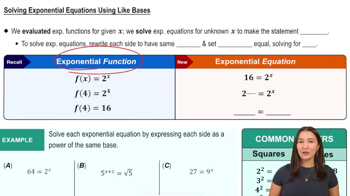
What is the first step when solving an exponential equation like 16 = 2^x?
Puoi toccare per girare la carta.
👆
What is the first step when solving an exponential equation like 16 = 2^x?
Rewrite both sides of the equation to have the same base, if possible.
Avanzamenti del tracciato
I pulsanti di controllo sono stati cambiati in modalità "navigazione".
1/15
Flashcard correlate
Pratica correlata
Video consigliati
Exponential & Logarithmic Equations definitions
Exponential & Logarithmic Equations
15 Termini
Exponential & Logarithmic Equations
0. Functions
3 Problemi
Argomento
Ernest
Introduction to Trigonometric Functions
0. Functions
5 Problemi
Argomento
Ally
0. Functions - Part 1 of 2
7 Argomenti
14 Problemi
Capitolo
Patrick
0. Functions - Part 2 of 2
8 Argomenti
12 Problemi
Capitolo
David-Paige
4:46
Solving Exponential Equations Using Like Bases
1109
views
10
rank
5:02
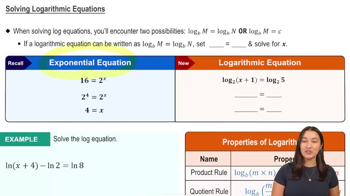
Solving Logarithmic Equations
886
views
7
rank
5:47
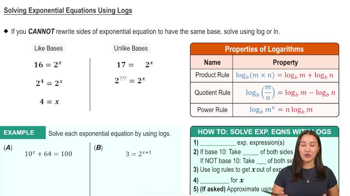
Solving Exponential Equations Using Logs
929
views
8
rank
Termini in questo insieme (15)
Nascondere definizioni
What is the first step when solving an exponential equation like 16 = 2^x?
Rewrite both sides of the equation to have the same base, if possible.
After rewriting both sides of an exponential equation to have the same base, what do you do next?
Set the exponents equal to each other and solve the resulting linear equation.
How can you rewrite 64 as a power of 2?
64 can be rewritten as 2^6.
If you have 5^(x+1) = sqrt(5), how do you rewrite the right side to have the same base?
Rewrite sqrt(5) as 5^(1/2).
What should you do if you cannot rewrite both sides of an exponential equation to have the same base?
Use logarithms to solve for the variable.
What is the first step when using logarithms to solve an exponential equation like 10^x + 64 = 100?
Isolate the exponential expression on one side of the equation.
When should you use the common log (log) versus the natural log (ln) when solving exponential equations?
Use the common log for base 10 and the natural log for other bases.
What log property allows you to bring the exponent down in front when solving for x in an equation like log(10^x)?
The power rule: log(a^b) = b*log(a).
How do you solve for x in the equation log(10^x) = log(36)?
Since log(10) = 1, x = log(36).
What is the general process for solving a logarithmic equation where two logs of the same base are set equal?
Set the arguments of the logs equal to each other and solve the resulting equation.
How do you solve an equation like ln(x+4) - ln(2) = ln(8)?
Use the quotient rule to combine logs, then set the arguments equal: (x+4)/2 = 8.
What is the next step after combining logs in a logarithmic equation and setting the arguments equal?
Solve the resulting linear equation for the variable.
How do you solve a logarithmic equation like log_2(4x) = 5?
Rewrite it in exponential form: 2^5 = 4x, then solve for x.
Why must you check your solution when solving logarithmic equations?
Because the argument of the log must be positive; if plugging in your solution gives a negative, it is not valid.
What are the two main types of logarithmic equations you may encounter?
Equations with two logs of the same base set equal, and equations with a single log set equal to a constant.
 IndietroIndietro

 4:46
4:46