Skip to main content
Calculus
Il mio corso
Impara
Preparazione agli esami
AI Tutor
Guide di studio
Soluzioni per libri di testo
Flashcard
Esplora
Prova l'app
Il mio corso
Impara
Preparazione agli esami
AI Tutor
Guide di studio
Soluzioni per libri di testo
Flashcard
Esplora
Prova l'app
Indietro
Introduction to Functions definitions
Puoi toccare per girare la carta.
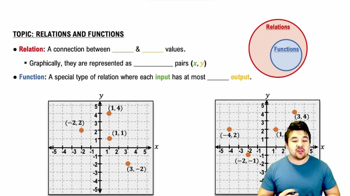
Relation
Puoi toccare per girare la carta.
👆
Relation
A connection between X and Y values, represented as ordered pairs, where each input can correspond to one or more outputs.
Avanzamenti del tracciato
I pulsanti di controllo sono stati cambiati in modalità "navigazione".
1/15
Flashcard correlate
Pratica correlata
Video consigliati
Introduction to Functions quiz #1
Introduction to Functions
10 Termini
Introduction to Functions
0. Functions
5 Problemi
Argomento
Patrick
Piecewise Functions
0. Functions
3 Problemi
Argomento
David-Paige
0. Functions - Part 1 of 2
7 Argomenti
14 Problemi
Capitolo
Patrick
0. Functions - Part 2 of 2
8 Argomenti
12 Problemi
Capitolo
David-Paige
VideoThumbView.guidedCourse
5:20
Relations and Functions
7572
views
282
rank
3
comments
1:36
Introduction to Calculus Channel
10611
views
266
rank
VideoThumbView.guidedCourse
5:10
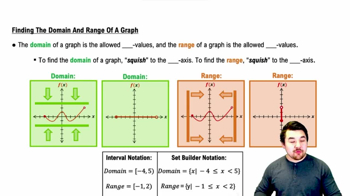
Finding the Domain and Range of a Graph
4095
views
181
rank
2
comments
Termini in questo insieme (15)
Nascondere definizioni
Relation
A connection between X and Y values, represented as ordered pairs, where each input can correspond to one or more outputs.
Function
A special type of relation where each input is paired with at most one output, ensuring no input has multiple outputs.
Input
An X value in a relation or function, representing the independent variable or starting value in an ordered pair.
Output
A Y value in a relation or function, representing the dependent variable or resulting value in an ordered pair.
Ordered Pair
A notation (x, y) showing the relationship between an input and its corresponding output on a graph.
Vertical Line Test
A graphical method to determine if a graph represents a function by checking if any vertical line crosses more than one point.
Domain
The complete set of allowed X values for a relation or function, often found by projecting the graph onto the X-axis.
Range
The complete set of allowed Y values for a relation or function, often found by projecting the graph onto the Y-axis.
Interval Notation
A concise way to express domain or range using brackets and parentheses to indicate inclusion or exclusion of endpoints.
Set Builder Notation
A notation using inequality symbols to describe domain or range, specifying the conditions that elements must satisfy.
Bracket
A symbol used in interval notation to indicate that an endpoint is included in the domain or range.
Parenthesis
A symbol used in interval notation to indicate that an endpoint is excluded from the domain or range.
Union Symbol
A symbol used to connect multiple intervals in domain or range, indicating the combination of separate sets.
Squish Strategy
A visual technique where a graph is compressed onto an axis to reveal the domain or range.
Open Circle
A graphical marker indicating that a specific value is not included in the domain or range.
 IndietroIndietro

 5:20
5:20