Skip to main content
Calculus
Il mio corso
Impara
Preparazione agli esami
AI Tutor
Guide di studio
Soluzioni per libri di testo
Flashcard
Esplora
Prova l'app
Il mio corso
Impara
Preparazione agli esami
AI Tutor
Guide di studio
Soluzioni per libri di testo
Flashcard
Esplora
Prova l'app
Indietro
Logarithmic Functions quiz
1 Lo studente ha trovato utile questo
Puoi toccare per girare la carta.
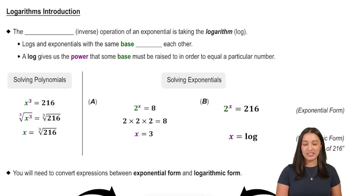
What is the inverse operation of an exponential function?
Puoi toccare per girare la carta.
👆
What is the inverse operation of an exponential function?
The inverse operation of an exponential function is taking the logarithm (log).
Avanzamenti del tracciato
I pulsanti di controllo sono stati cambiati in modalità "navigazione".
1/15
Flashcard correlate
Pratica correlata
Video consigliati
Logarithmic Functions definitions
Logarithmic Functions
14 Termini
Logarithmic Functions
0. Functions
4 Problemi
Argomento
Ernest
Properties of Logarithms
0. Functions
4 Problemi
Argomento
Ernest
0. Functions - Part 1 of 2
7 Argomenti
14 Problemi
Capitolo
Patrick
0. Functions - Part 2 of 2
8 Argomenti
12 Problemi
Capitolo
David-Paige
7:30
Logarithms Introduction
1334
views
30
rank
2:51
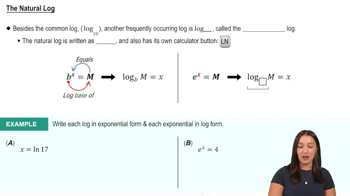
The Natural Log
926
views
19
rank
5:26
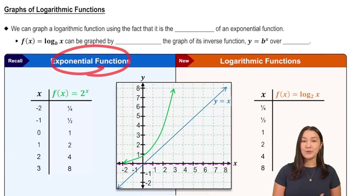
Graphs of Logarithmic Functions
878
views
18
rank
Termini in questo insieme (15)
Nascondere definizioni
What is the inverse operation of an exponential function?
The inverse operation of an exponential function is taking the logarithm (log).
How do you isolate x in the equation 2^x = 216 using logarithms?
Take the log base 2 of both sides to get x = log base 2 of 216.
What does log base 2 of 216 represent?
It represents the power to which 2 must be raised to get 216.
How do you convert the exponential equation 3^x = 81 to logarithmic form?
It becomes log base 3 of 81 equals x, or log₃(81) = x.
How do you convert x = log base 4 of 64 to exponential form?
It becomes 4^x = 64.
What is the common logarithm and how is it written?
The common logarithm is log base 10, and it is written simply as log.
What is the natural logarithm and how is it denoted?
The natural logarithm is log base e and is denoted as ln.
How do you convert x = ln(17) to exponential form?
It becomes e^x = 17.
How do you convert e^x = 4 to logarithmic form?
It becomes ln(4) = x.
What is the relationship between the graphs of exponential and logarithmic functions?
The graph of a logarithmic function is the reflection of its corresponding exponential function across the line y = x.
What is the domain and range of a logarithmic function?
The domain is (0, ∞) and the range is all real numbers (−∞, ∞).
Where is the vertical asymptote of a logarithmic function located?
The vertical asymptote is at x = 0.
How does the base of a logarithmic function affect its graph?
If the base is greater than 1, the graph increases; if the base is between 0 and 1, the graph decreases.
What is always true about log base b of 1 for any base b?
log base b of 1 is always 0, regardless of the base.
How do you remember the notation for the natural logarithm?
Take the first letters of 'natural log', reverse them, and you get 'ln'.
 IndietroIndietro

 7:30
7:30